20111128

WHAT YOU WILL


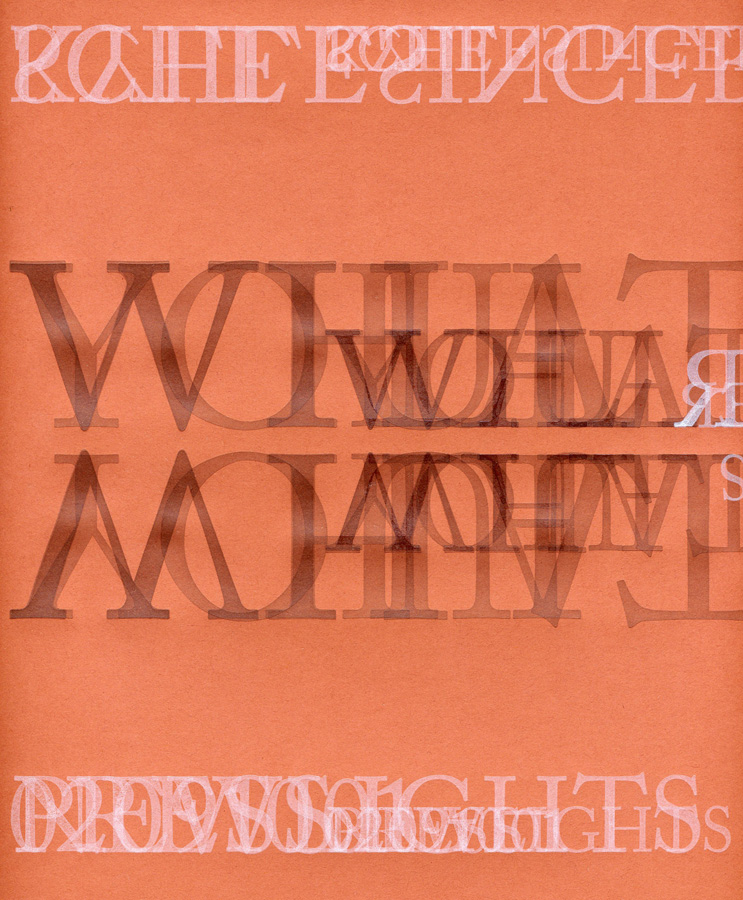
What You Will, a new book of poems by Kyle Schlesinger! It’s done! It’s out! & it wants to live in your home!


Poems by Kyle Schlesinger
44 pages, double signature pamphlet stitch with folded jacket
4.375” x 8.75” (closed)
Letterpress printed in three colors from photopolymer plates
Edition of 100
All copies are signed by the author
2011
$20 (plus shipping)
Out of Print


20111121

PRODUCTION IS RECEPTION (36): AS-OF-NOW UNTITLED (2)

Still no title. I think it will probably have to wait until the end. The writing began in earnest in over the weekend, finally, and as this long weekend approaches, maybe there will be significant progress. What follows is the middle of the in-progress draft, two braided threads of text:

[…]

& it can cut deeply & it will be impossible to put it back together again; you can never read the same book twice, you can never go home; time passes; every piece of light is brand new in the unstoppable wave of time; & your hands are hopelessly wounded, scrawled with characters, words, gestures, trembling; terrifying machines in the terrifying light; try and try, your hands will never arrest the book in time; all you can do is bleed &

—a morning with folds, fast heartbeats, folds, and joy; joyful light shining through this glass, this stain; it is the morning, a blemish, a blush; the already scarred face of a new day; gorgeous in the light and twisted like that; red like that; read like that; brown, white, blue, yellow, white; and sheets turning folding; waking in the wake of this light; this day; this light; this day; this light; this day; this light; always new in every repetitive push; this terrifying machine; this time; this day; this light; turning and the light pushes through, awkward, groaning, fumbling, the light passes bashfully; this morning; stripped down to thick & bright, this white gorgeous in the way that it is read; never a sight as such in darkness; never a site as such in darkness; this is joy; this morning; this sight; this is sight; and waking; this morning; made; this light; unmade; folds; the mechanics of these things are incredible; movement, the way movement happens; always new; this day; this light; as such; thick & hanging, everywhere; like that; just like that—

& this is the ultimate measure of time &

—this is where we can begin, thankfully;
[…]

I spent some time playing around with different structural conventions, on how to break the phrases in way different from the “natural” sentence. I don’t know if this solution will be the one actually used, but we’ll see—I do like the rhythm. I’ve also been thinking about the punctuation conventions of early manuscripts, before the rules of punctuation had solidified at all.

And the “normal” text is written only using “you” and “it” as pronouns, while the italicized text is only written using “it.” Very simple structural choices or exclusions like those can help to build very strange texts.

20111118

DON’T DETERMINE ON ME


The following excerpt is from the article “The State of the Book: A Conversation,” by Johanna Drucker and Buzz Spector, which is in the printed Printeresting edition of The California Printmaker (the journal of The California Society of Printmakers), p. 20. [Ed. Note: Totally worth buying and reading and owning.] This particular part is Johanna Drucker:
But as we shift towards the multi-platform possibilities that the current media environment offers, what changes will it make to our work? I find it very useful to use all media for their distinct capacities—aesthetic, production, distribution, affordability, etc.—but know […] that media only offer opportunity, they don’t determine anything. As I’ve said many times, the technical ability to produce avant-garde typography (i.e. Futurist and Dada compositions) was present in Gutenberg’s shop. The cultural disposition towards such innovation did not exist. Such work could not be conceived. Sure, shaped poetry has a long history, into antiquity, and all written language makes use of graphic affordances, but mixed font, diagonal, radically cut-up typographic work has as much to do with the bombardment of the senses in urban spaces by polyglot and multi-modal communications in verbal forms (radio, posters, newspapers, journals, advertising, film) as with technical innovation. [emphasis added]
I think that the point that Drucker is trying to make here is an important one: that any media in and of itself has no “natural” state, no “natural” progression that the work in that media inevitably follows. “Media only offer opportunity” to human and institutional agents. This is also the whole point of The Nature of the Book, by Adrian Johns, which talks about how everything we take for granted about books & print was not always so, and were constructed over time, differently in different places, through an extraordinarily complex set of conversations, arguments, laws, and practices. To cite a modern example, the Internet is not inherently and naturally “democratic,” and could/can/is be used for insidious and/or overt social control—all in the name of justice, of course.

What does this mean for us, now, in the opening stages of a possible shift from print to electronic text? It means that we shouldn’t let corporate/media/money interests tell us what the future is—it means that we must share in the active shaping of it. Which is why this is such an exciting time to be doing all of this writing, publishing, making, designing, shaping, becoming, occupying, sharing, talking…

20111116

AFTER MATH

It’s always a strange thing to finish a large project. Suddenly an absence, and not-knowing creeps back in, nestles under the covers. But there is rest. Hopefully today What You Will will arrive in Austin, and I can hear what the author thinks. We’ll see.

Ordinarily we would release the book as soon as it’s finished. With this one we’re waiting a bit, mostly because of Thanksgiving. (The release will be Monday, Nov. 28.) Which is good, because it will give us more time to coordinate the release and promotion. And promotion is something that NewLights need to work on, as noted in some earlier posts. And also distribution logistics—I’m still not happy with how shipping options are set up with our PayPal buttons. But there is time to work all of that out, and it’s not necessarily interesting to anyone but me.

This morning I was thinking about a “book trailer,” which is something that I’ve seen other small presses doing, for at least a couple of years (maybe more?) now. Usually they’re videos. We’re not really set up for video production, so maybe if we do a trailer it will be in digital book form, images and text from the finished piece, plus images and text from the process of making it.

But perhaps the most important question at this point is, “Now what?” Not in the sense of what book is coming next, because the publishing schedule is set for at least the next year, but in terms of what NewLights can be/do. Where do we take things from here? That question, of course, is always there, but sometimes it is repressed by a series of tasks-at-hand, only to come rushing back in every quiet moment, hanging, a filter through which all of our breath gathers, a window through which all of this sunlight passes. A new day shivers. It is winter, the air around us is cold. And so warmth blooms in action.

20111114

WHAT YOU WILL IS COMPLETE


Finally, after nearly 2 years. Now they will be sent to the author, Kyle Schlesinger, so that he can sign them. They will officially be released and available for purchase in exactly two weeks, on Monday, November 28.

20111111

PRODUCTION IS RECEPTION (35): AS-OF-NOW UNTITLED (1)


Each book begins with a series of notes: the specs of the project, lists of related ideas, attempts at written sections, etc. Often all of these things swirl around in my brain for days or weeks before I actually sit down to write them. But actually writing them down is important, for a variety of reasons: 1) it records ideas so that they are not forgotten, 2) it takes ideas out the nebulousness of the mind and helps to build specific connections between them, 3) it begins to give the idea a (loose) shape, and 4) when the ideas are outside of my mind/voice, I can evaluate them more objectively and effectively.

The conceptual composition grows. It is not always a temporal-linear growth—sometimes it’s necessary to return to the beginning, either to harvest a particular idea, or to reboot a project that is getting out of hand. Things change.

What follows is the current state of the notes for a new project, the next book, a small insert to be included with the next issue of JAB. Other pieces can be found in posts below, and the image above is a second visual mock-up.

&&&&&&&&&&&&&&&&&&&&&&&&&&&&&
Letterpress & offset. Initial idea: use each medium for its strengths. New idea: use each medium for its weaknesses, or for qualities outside of transparent reproduction.

What is offset not good at?

Offset:
Cover each page in multiple layers of opaque white, building back up to the silence of the page/white morning light. Print text with hard impression still visible under the offset layers. Different colors/shapes under the white? Different colors of paper? (The Heads)

What about solid black? Or black & white? Or other solid colors?

A book about light? Newton’s Opticks. Photographs. What about actual reproduction driven to abstraction? A photograph of the Rothko blinds in the morning. Close-ups of her skin in the morning light—filling the frame and covering the debossed text.

New plan. Offset, CMYK photo images of color fields in the morning light. Letterpress text, in negative, on top of those, in transparent colors and/or opaque white. Two or more “braided” lines of text. Use of perimeter text idea.

Writing without pronouns? Or indeterminate pronouns?
How do we move in the morning? Where does the world lie? As blinking, breathing, rising. It turns. It is suspended.

How do we move in the morning? Where does the world lie? As blinking, breathing, rising. Turning. Suspended. As light as such. Something in the spine stirs, folds, folds over. As blue light, now white light, stretches. The window sagging in the light. The light dizzy in the window. Morning. Reading. Stretching. Stretching over and across. Lines across an open body. Folding.
Perimeter text could be a “list”: turning, moving, breathing, etc. Maybe not. Definitely not.

Font for interior text? Low contrast roman. Palatino? Centaur? Poliphilus? Investigate cost. Italic paired, instead of sans serif? Needs to print well in negative. Placard for perimeter text, possibly Arial/Helvetica.

How do the lines connect? What is each line? Above example could be perimeter. Could also be italic. Does use of italic make the “poetic” voice subordinate to the “theoretical” voice?

Structure: the page as unit (how many words?). Two sections of main text, each readable independently, forwards or backwards, and also able to be read in linear order. “Blank” sections? How to use? The swerve. Too much? Too “written?”
Reetum vel init adio esequat. Ut vel delisis nummy non ut doloboreet dunt vulluptat, sequat.
Tat. Duisit la facilit lumsan vel ercillaortio con velisci llandrem nullan et velisissim am, vullaorem alit, quis ametum quismod dit nim nonse magna feu facipsu scilit wis augue dolorer incin henim doluptat. Atin ullamet lumsan volesse feuis dolor in utpat. Ut lum acinit alit volore ming ea auguer susci tem vel utpat, cons ex et incipit augiam, core dolum dolore cor si bla alit adigna facillandre dolor se ver si blan vel erat, conulpu tpatue feu facidunt wis aliquat, quat dit nulla cons ea con henim dolor at incil et, quam, cons enit dunt autpat praesenit autatumsan utat. Duismod olobore dolore vel dolessenibh et velenismodo eu facin enibh el iurem dolenim zzrit in henim ipit, conullan ulluptat. Ut lan estrud min esse minci bla feugait estrud te feum zzriure dolortin eugait delit prat. Ut at. Ut il deleniam in vullutat Um nisi. Rud tis niamet nulput ad modolore te ea
165 words per section. Rough estimate.

20111109

WRITING IS DESIGNING


& designing is writing. The image above is the first go at a layout/structure for the spreads of the next book. Just roughing it in.

20111107

PRODUCTION IS RECEPTION (34): WHAT YOU WILL (20)


Entangled. Now that binding has begun, it’s hard to think about anything else besides getting these books done. They will be finished by the end of the week, even if I move at a moderate pace. After they’re finished, they will all be mailed to Kyle to sign, and then when they come back to me, they will be released and available. Probably in about 2 weeks. At last, at last.


Compiling, collating, stacking, binding. This is one of the strangest parts of the whole activity—when all of those fragments are drawn together into a moving whole. Ostranenie. The book never looks how you dreamt, never looks how you remember. It takes its shape gradually, through folding and sewing, and then through pressing and trimming. It expands, it contracts, is hewn from space and time, plane, line, and point, bending, sagging, twisting, moving. An object in the world, subject to. As light as such. Always almost there, almost done, almost there, almost done, almost there, almost done. And so on. It bends.

20111104

STUDY: COLOR & SEQUENCE


This is the first part of a new project, the base layers/sequence for our first offset/letterpress combo book. 

It's amazing how weird and plastic-looking the "pages" look in this viewer. The final book will not only look like (and actually be) a real book, but there will be many other layers and text and other fun things as well.

20111102

PRODUCTION IS RECEPTION (33): WHAT YOU WILL (19)


Printing is complete. Final count: 202 press runs. & binding has begun.


20111031

MY GIRLFRIEND'S ARTWORK IS AWESOME


And now you can buy it on Etsy. Which you should. And look at more at http://www.coriecole.com Small press people: buying this work does (indirectly) support small press publishing. Everything, as always, is connected, and these things are human things.


20111026

NOW (NON)LIVE ONLINE: SILVER STANDARD BY JUSTIN SIROIS


Poems and images by Justin Sirois
56 pages, softcover, with printed and stapled dustjacket that adheres to book through a series of magnetic strips, double signature pamphlet stitched, 8 1/8” x 5 1/8”

Letterpress dustjacket & cover, digitally printed pages, staples, magnets
Edition of 100

2006


The middle of this book has two fold-out pages. We did our best in translating them to this digital version. The image below shows what they look like and how they work in the real thing:


According to the website of Apollinaire's Bookshoppe, they still have some copies of silver standard available for purchase!

& the original post about this book can be found here.

20111025

SUPPORT FUTURE TENSE BOOKS, SUPPORT THE WORLD


An independent press that’s been operating for 20 years? Trying to raise money so that they can expand their production? Sold! I’m in!

Find out more and donate here.
And visit the Future Tense website.

20111024

PRODUCTION IS RECEPTION (32): WHAT YOU WILL (18)

I have not so much been absent in these past two weeks, as present somewhere else, in the workings of that other press. But I have managed a few things during that time, specifically more press runs on the jackets for What You Will:


Only 10 runs remain.

20111013

A FEW THINGS, ALL CONNECTED, AMEN


Been away for a few days while not really being away—some busy mornings with no time to write. So we’ll ease back in with a few announcements of things:

The venerable poet, printer, and thinker-of-all-things-book, Alan Loney, has recently started a new blog for his imprint, Electio Editions. There are some good posts with lovely images (like the one above) of lovely things up there already.

A new press has started in our former home of The Bay Area: Zumbar Press, which is focused on producing letterpress chapbooks and broadsides, as well as documenting that process of construction (something we here at NewLights can certainly support). Only 9 copies of the first broadside remain.

And this new press in the Bay reminds me of Lyn Hejinian’s Tuumba press, which undertook a similar project, beginning in the 70s and continuing and discontinuing until now & into the future. There is a great interview with Lyn in the new issue of Mimeo Mimeo, which just came out. Get your copy here. Then subscribe.

And also in that issue is an essay about poetry and typography by the aforementioned Alan Loney.

Mimeo Mimeo gets thicker and better with each issue. Which is good for all of us, good for the world. 


20111007

EVERY DAY

OCCUPY the places and channels of power. The spaces in which power is exercised. The means by which we are subjected to their objects. OCCUPY the role of producer. TAKE IT BACK and show the world that we have been producing all along. OCCUPY the channels of meaning and knowledge. DISTRIBUTE everything you have ever loved and could love. TAKE CONTROL of what you consume, BREAK IT APART and show the shattered surface to the rest of the world. KEEP LOOKING for more cracks in everything and OCCUPY them. TAKE CONTROL of every possible media, show us what it is, what it can carry. DO NOT STOP until we can see that we DO NOT UNDERSTAND IT ANYMORE. There will probably never be any rest. GIVE IT ALL AWAY. The sunlight is the only model. OCCUPY your life in such a way that it is continually BURSTING, overfull. TEAR OFF THE TOP OF YOUR SKULL and LET YOUR MIND TOUCH SPACE & HISTORY. There is no such thing as GENIUS. There is no such thing as BOREDOM. IT IS ALL IN YOUR MIND. OCCUPY your language and the way that it MOVES IN THE WORLD. BURN AWAY the hardened, dried, blackened EXOSKELETON OF YOUR SOUL. It does not belong to you.

LOOK HARD.
LOOK AGAIN.
PAY ATTENTION.
LAUGH HARD.
WORK HARD.
WORK LATE.
SLEEP WELL.
BE GENEROUS
BE KIND.
LOVE FIERCELY.
OCCUPY EVERYDAY.

20111005

SOMETIMES THE BOOK SHOWS ITS TRUE FACE


The image above shows a random, beautiful moment that I found in an old book that I borrowed from Tutt Library here at Colorado College. The book itself is Milton’s Areopagitica and Other Prose Works, (London: J.M. Dent & Sons, 1927). This page spread is the opening of Milton’s “Of Education,” which was written in 1644. This marked up and cut down spread is a fantastic chance composition, but it also demonstrates the multi-authorial nature of this particular (and by inference, any) book. The large print is Milton’s original text. The smaller type before that is the editor’s introduction to this particular piece. But beyond that there are the authorial voices of the typeface, design, typesetting, and printing, by themselves and as a visual unit. There were also multiple binders/bindings, evidenced by the cropping off of the marginalia, the highly visible sewing, and the bright orange “library” bookcloth. & of course there’s also the marks of the former readers/owners. Did the same person make the notes in black, do the underlining in red, and fill in the “O” in “Of Education?” These two pages show the construction, destruction, and reconstruction of the text/book through time. The wonderful marks of a life lived living.

20111003

MACHINED, or THE HAND-MECHANICAL (12)

Looking at the ILSSA hand-mind essay that I’m working on this morning, and I see that although progress has been made, it remains a bunch of tenuously connected ideas. Here are a few of them, far from perfect, coherent, or done:

The example above [below on this blog], of an observational painting exercise, is quite literal as a representation of both “mind” and “hand.” But “hand,” or the use of it, does not necessarily have to be tied to the body part. “Hand” does not strictly mean the manipulation of something physical—although any interaction with a linguistic or conceptual object is mediated somehow, often through technology, like the typing and typesetting of this essay. “Hand” essentially means active or engaged. When someone writes or critiques the discourse of any given field, they are participating in it, manipulating the field and its (linguistic/symbolic) objects. Any act of participatory creation involves “the hand,” in its broad sense, at some level—and thus the hand becomes the mind, and the mind becomes the hand.

The hand and mind are connected, and that connection is attention.

The work of the hand allows for a “making strange” in the mind. The act of construction forces the mind into an observation of reality, of the here and now of an object being built. The observations of the mind refine the work of the hand against and to the mind’s original projected ideal. Every creative act is a continuous mediation and remediation between the ideal of the original idea (generated in the mind) and the reality of the thing-in-the-world (generated by the hand). The constantly attentive attention of the hand-mind feedback loop generates new knowledge, or reinforces/refines things already known. That knowledge extends the attention paid into the future, to new activities, new objects, new meanings-in-waiting.

The hand-mind feedback loop is analogous to the artist-audience feedback loop. The artist, engaging their own individual hand-mind, acts as the experimental, knowledge gathering hand of the culture. The audience members (at once individual and collective) engage their hand-minds to construct new knowledge/meaning from the objects made and presented to them. This new knowledge/meaning travels back to the artist, and is refined and manipulated further. The social space of art is a constant cycle of production. The social space of art is the feedback loop between artist and audience.

20110929

MACHINED, or THE HAND-MECHANICAL (11)

The past few mornings and nights I have been writing an essay for a forthcoming ILSSA publication. The essay is about “hand/mind.” (This is a part of a small series of essays by multiple people—the other subjects are “old/new,” “work/play,” and “time/money.”) Below is the opening paragraph (as it stands, here, now, this morning):

Look hard was the dictum of the class. We were attempting to make accurate, representational, still-life paintings of white on white tableaus—eggs and white ceramic ware against white backgrounds. One thing that became almost immediately clear was that the idea of white—pure, bright, disembodied, unmodulated—did not map well against white-in-the-world—never pure, wrapped around objects and/or embodied in pigments, and always appearing in shades of gray mixed with reflected and projected color. This fact became apparent to this group of struggling students very soon, but it became apparent not in the abstract of language (as it does in this essay) but in the actual practice of painting that we were engaged in. The linked act(s) of looking and making were de-verbalized, connected in the building of moments, and existed as concrete moves and the testing of procedures. We were studying representational painting. We were studying the mechanics of representational painting, and the knowledge that we were developing existed in the circuits between hand and mind. Only later, during class discussions, did we attempt to represent that knowledge in language; but our understanding of each other’s comments was always filtered through the work of our own hands. Knowledge is always connected to practice.

20110927

PRODUCTION IS RECEPTION (31): WHAT YOU WILL (17)

This will be the last post documenting the layering and building of the covers of Kyle Schlesinger’s What You Will, because them covers are done gloriously done.


This is a good way to preview the book in its entirety, because the book is reprinted, in its entirety & exactly in position, on the cover. You are seeing the entire book collapsed. This is what time looks like.

I am intrigued by the surface of the printed areas, by how the ink and (non)color built up, and by how the edges and impression of the different plates left different marks. There is something in these covers that can be expanded into future books—an approach, an idea, an insistence on the physicality of the printed object. Books are for handling, after all. These covers are like oil paintings that you get to play with, finally.


Only the jackets remain to be printed. Only 24 more runs. It won’t be long now. This is how time stands as a wall against our bending backs.

20110926

BEING INSTITUTIONALIZED IS UNCOMFORTABLE (7)

And one thing that had made me very uncomfortable last week was the reactivation of my Facebook account and the creation of a page for NewLights. One concrete issue that the BlazeVOX discussion brought to my attention is that I could/should be doing more to get the word out about the books. The NewLights Facebook page is a start to that. “Like” NewLights and then you’ll get to watch me figure out how to use that page as an effective way to communicate, in painfully slow, discontinuous, and awkward “real” time. I know that sounds enticing. It will also be a good way to get news if you don’t like this blog. Or to get news easily separated from the rest of this mess. Or something. Anyway, here’s the link, one more time, who doesn’t want to like and be liked:

http://www.facebook.com/pages/NewLights-Press/276760435686307?sk=wall

Any other small presses out there, I would love to be pointed to your pages as well.


And there will probably be a Twitter account in the future too. Yikes.

20110923

NOW (NON)LIVE ONLINE: THE COLLECTED BOOKS OF JACK SPICER


You can see the initial post about this book here.

20110921

FOR RODCHENKO


For Rodchenko/For Travis:
Working Notes Toward The Heads

NewLights Press: A. Cohick, et al
3 digital books, 96 pages each, 9” x 12” (open)
Pure RGB colors
Edition determined as viewed
2011
Free

20110919

BEING INSTITUTIONALIZED IS UNCOMFORTABLE (6)


In the last post on this topic I wrote: “For a person to set up as a publisher and declare themselves an editor without any socioeconomic vetting by an acknowledged institution of authority (one with money & power) is a subversive act.” I’d like to explore that statement a little more, grounded in a particular experience.

Many years ago now, when I was living in Baltimore, I was acting as the “Project Coordinator” of the Dolphin Press, which was a fine press run out of the Printmaking Dept. at the Maryland Institute College of Art. NewLights had been started by then too. Running Dolphin was a volunteer position—a stopgap measure to keep the press producing during a time of little/no funding. The Dolphin Press, in any official sense, did not exist. But I figured it was good “professional” experience—and it was.

I put “professional” in quotes, because, back then, even more so than now, I really had no idea what I was doing or what I was supposed to do. But enough background—this post is supposed to be about the subverting of institutional authority.

At some point during my time at Dolphin, one of the other departments at MICA purchased a book from the press, and, naturally, asked for an invoice/receipt. Of course nothing like that existed, so I had to make one. I kept thinking something along the lines of: I’m just some normal jerk, I can’t make or issue an invoice. I don’t have the authority to do this. I did it anyway, of course. I made an invoice for a transaction between two academic departments—one of which was imaginary.

The small press world, though, as a whole, is imaginary. Imaginary despite the aching muscles, the bottomed-out bank accounts, and the stacks of wonderful books. Our imagination will tear us apart from the inside.

A year or two down the road, when it became time to design an invoice for NewLights (when actual businesses (bookstores) and other institutions (libraries) started buying things), I realized that the detritus of the institution (“the institution” in the general sense)—its forms, invoices, documents, correspondence, paperwork—is one of the major things that constitute its identity outside of its local time & place. Thus the strange looking invoices, correspondence forms, inspection slips, etc. that NewLights uses. Such things are the flimsy foundation on which this imaginary institution rests.

What makes a press “real” and what makes it “imaginary?” Is it a physical location? Is it money? The things that it publishes? Its paperwork? Its tax forms? Its ISBN numbers? Its authors? Its publishing practices? How all of those things congeal into an image of “the press” in the mind of the public?

20110916

PRODUCTION IS RECEPTION (30): WHAT YOU WILL (16)


The image above shows the covers of Kyle Schlesinger’s What You Will as they now stand, to change again tomorrow. The versos now have all of the poems, 12 of them, printed (the white rectangle on the left side). There will be five more plates printed on that side, from the title sequence. & one run of scoring and the covers are complete.

The images below show the jackets with the first two runs on them. Please excuse the colors on these images—the lighting in the studio is awful for photos. The last image is the most accurate, color-wise.


20110915

BEING INSTITUTIONALIZED IS UNCOMFORTABLE (5)

I remember reading a comment on an HTMLGiant post a few months ago (I have no idea which post) where the commenter was talking about how anyone can set up a small press or journal and declare themselves an editor, despite any actual qualifications and/or experience they may or may not have. And I think that’s an accurate observation—when I started NewLights I had no idea what it meant to be an editor, how to be an editor, what an editor actually did, etc. I still don’t, really, which is one of the reasons why I am interested in this conversation.

What is it that we actually do?

For a person to set up as a publisher and declare themselves an editor without any socioeconomic vetting by an acknowledged institution of authority (one with money & power) is a subversive act. It is a usurpation, a move against power bestowed, a move for power built up from the ground. Built up from the ground in the sense that the self-appointed small press editor openly acknowledges their lack of institutional approval, but declares, through their actions, that “I/we will learn this, figure this out, build this up.”

I started the NewLights Press in May of 2000. All I had was access to a print studio (I was in school), a copy of A Secret Location on the Lower East Side, and a need to make books. I certainly did not have a clue. I didn’t know of any other small presses operating in Baltimore at that time (there were some). Websites for such operations were becoming more and more common, but for a 20 year-old still seemed very exotic. This is not a “let me tell you how hard it was back in my day” passage—it’s an attempt to establish the fact that the social/cultural context in which small presses begin and operate now is radically different than what is was just 11 years ago. The closeness of the community and the long reach of small presses now is a consequence of electronic communication and the ever-accessible “storefronts” of our websites. And this context continues to change—we will see how digital books and e-readers play out. Almost every day we read about how big publishers are struggling. Almost every day we read about another small press that has started up.

Publishing/running a press is, like just about anything, a process. And it’s not a straight climb towards ‘better” work or more sales and more secure financial foundations. It fluctuates, sometimes with astonishing rapidity. If small presses gave up because they could not figure out a way to make a profit or at least break even, then almost all of them would close down after a year or two, or five or seven years down the road when things got rough. And no matter how promising a start, things will get rough.

The higher the profile of a press, the more “anonymous” its operations become—it begins to attract an audience and potential authors outside of an immediate, local community. And thus the press needs to become more “professional”—more like a large publisher. With that comes accountability and transparency.

NewLights, despite being the same age as BlazeVOX, has remained a much smaller operation, with a different (but overlapping) set of goals and interests. And because of that I really don’t think too many people would give a damn if I started asking authors for money. Some people wouldn’t like it, for sure, but there would be no big outcry. And any discussion/argument that might ensue about it would happen under very different terms, because NewLights operates under very different terms.

There is a fine line to walk between asking small presses to operate under certain community-approved standards and hollowing out their identities and practices. One of the things that make small presses great is the fact that their practices are person to person. When they begin to detach from that local, personal interaction without being able to predict and account for the consequences, nasty messes can ensue.

20110913

NOW (NON)LIVE ONLINE: THE NEW MANIFESTO (FIRST ITERATION)

The first digital version of a NewLights Press book (The New Manifesto of the NewLights Press (first iteration)) is now here and available for your reading pleasure. More out-of-print (and probably some in-print) titles will be added as the days get shorter.


20110912

BEING INSTITUTIONALIZED IS UNCOMFORTABLE (4)

A week has passed since the initial furor of the BlazeVOX incident. I am trying to continue using the event as a springboard for an analysis (a haphazard one, to be sure). As time goes on this is less about the specifics of what happened and more about the conditions that allowed it to happen (or produced the event), and an attempt to string together something productive in the aftermath. I am trying to pay my attention.

If there’s one consolation that Geoffrey Gatza (the editor/founder of BlazeVOX) can take from the whole controversy about his publishing practices, it’s that people in the small press community care about what BlazeVOX is doing, and that the press has become a major force in the scene (it actually has been for awhile now).

And of course, in the sense of “any publicity is good publicity,” even more people know about the press now.

But in the exchange we saw the cost of that high profile. It raises the bar for what people expect from a press. And it seems like the small press world, whether we like it or not, is becoming more professionalized, and the presses that operate in this world are becoming more institutionalized, more public. Sometimes, they are becoming more business-like—even if that business continues to lose money.

Changing technology has helped to increase the public profile of small presses. Websites and internet publishing and sales have been around for awhile now. Public sites where discussion is an active part, like blogs, are more recent but very widely used. Social networking sites as a means of promotion are also thoroughly integrated into how we work. Another more recent trend has been book trailers—video ads for books meant to be posted and shared. And there are ad spaces on websites as well. All of these things are good things—they help to get more books out into the world and help to bring sales to authors & presses.

Writing is generally thought of as a solitary activity, and for the most part, it is. Publishing has been, historically, always a group/public activity, utilizing different people and businesses with different areas of expertise. A press like NewLights, where I can take a book from initial concept to final distribution, is an exception, not the rule. Publishing is, in one aspect, the construction of a channel through which artworks can be disseminated—publishing is public, both in “intent” and “structure.” But at the same time, the process of bringing together a book, for a small press, is often a very intimate affair, involving a fair amount of work done in solitude, or with a very small group of collaborators. This small group is often just editor and author, as the editor tends to do most jobs at the press. The experience of bringing a book together is not that different from the experience of writing a text—it involves a closeness with the work, it is mediated by technology, the decisions made are aesthetic as well as practical, and it is done with a potential audience in mind. Publishing is a creative act, productive in and of itself, and is not simply, as stated above, “the construction of a channel through which artworks can be disseminated.”

We could say that the identity of the press is constructed within and by the interactions of the object that it produces with its audience. In this formulation the press is an always still-forming social entity. It is social and political.

We could say that the identity of the press is constructed in the process of production (before a publication’s public life), in the interactions of its constituent parts: author, editor, designer, printer, etc. In this formulation the press makes finished things that are then distributed after the fact. It is authorial.

We could say that the identity of the press is constructed in the reach of its publications, in the reputation of its authors, and in the dollar amount of its sales. It is economic.

We could add more. None will be correct.

More soon.

20110908

BEING INSTITUTIONALIZED IS UNCOMFORTABLE (3)

Curses—it looks like I’ve spent most of my blog writing/coffee drinking time reading, trying to catch up on recent conversations on the BlazeVOX controversy. Much good discussion continues. A few quick questions have sprung to mind:

1) What is the role or job of an editor/publisher? Are an editor and publisher the same thing? Are a “role” and a “job” the same thing? What are the images of the small press editor/publisher being constructed in this debate? How do those images map to actual experience?

2) And parallel to that, was is the role or job of a writer in the small press community? What images of the writer and her/his role are being constructed? How do those images correspond with our lived experience?

3) What specific publishing practices are being marked as illegitimate? What practices are being marked as ones to emulate? How do presses identify which practices are best for them?

4) What does the general call for transparency in publishing practices tell us about the how we view or exist in our community? Does a move toward transparency signal a shift in the development of the community’s professional identity?

5) Am I any good at what I do? How can I do it better? What are my priorities as a publisher? How do my priorities match up with what other members of the small press community believe they should be? Should I care?

6) What makes a small press successful? What makes a small press legitimate?

7) Is there something productive, and I mean that in the sense of an actual product (I always return to making), that can come from this?

20110907

BEING INSTITUTIONALIZED IS UNCOMFORTABLE (2)

[It occurred to me this morning that I forgot a perhaps important part of the disclosure in the first post about this. Not only do I know several people who have been published by BlazeVOX, but the NewLights and BlazeVOX list of authors overlap slightly. This has since been amended in part 1 as well.]

Over the summer and now into the fall (soon, closer every chilly morning) I’ve been reading The Nature of the Book, by Adrian Johns (University of Chicago Press, 1998). It’s a work on the history of printing, focusing specifically on printing in early modern London, from roughly 1500-1800. It describes how printing, as an idea and as a practice, was constructed in that time and place, how the players involved (authors, printers, binders, booksellers, the state, the crown) actively created the discourse surrounding and fueling the new craft. The book demonstrates how everything that we take for granted about printed books (their fixity, their reliability, etc.) were not always givens and had to be developed over time through a complex array of discussions and the implementation of various regulatory practices, both informal and formal. It’s a very interesting book.

The reason that I mention it is because the BlazeVOX controversy is, essentially, exactly the same historical process being described in the book—this time happening in and around small press publishing, here and now. This process has been going on for a long time, outside of the current BlazeVOX discussion, but its recent intensity, coupled with my current reading, has finally made the process visible to my often belated perception of such things.

The parallels between the functioning of the small press world, bound together now by digital media, and the public discourse of early modern London (and other European and colonial cities & countries) are many. Blogs are the equivalents of early pamphlets: short, printed texts about current subjects, distributed widely and cheaply. And the comments section of the blogs and social media sites are the equivalents of the coffeehouse or tavern. And the stakes here are real, just as they were then, even though they are being played for outside of any legal system. The financially precarious world of bookmaking and selling in early modern London was based largely on reputation, and by extension of that, credit. The reputation of a major small press publisher of innovative poetry is being contested now. And in this world in this time, the reputation of a press remains one of the most valuable things that it can possess.

In McLuhanish terms, the “global village” inaugurated by the new media of the mid-twentieth century is being hybridized, through contemporary digital media, with the rowdy city of the “typographic man.”

The BlazeVOX controversy is a spontaneous, collective, public disciplining of the small press world, particularly of the publishers. [My hope is that it will help us change our practices for the better. I think it will.] Small press publishing, especially publishing focusing on avant-garde poetry/fiction/non-fiction, has been, historically, a practice almost entirely regulated by social (not legal) norms and interactions, often unspoken and intuited through “regular” social interactions. Almost entirely—the US government did get involved in prosecuting some publishers (City Lights, Grove) for obscenity. But those cases were in a sense not just about small press publishing, as they had bearing on the entire literary community in the US and other countries. But for the most part, the practices of small press publishing have been constructed outside of any official legal setting. And because of that they have been very unruly, uneven, haphazard, criminal at their worst, heroic at their best—messy. Wonderfully messy.

We have found ourselves in the midst of a particularly messy part right now. I’m sure that the fiery parts of this controversy are over, and many people will want to forget about it (if they even wanted to pay attention in the first place), but I want to continue this series of posts in the hope that something productive can be elaborated out of this “crisis.” What that something is, I’m not sure. But I do believe this is an important process and discussion. And I imagine the NewLights contribution to it being just as uneven and haphazard, undisciplined, as the discourse in the community as a whole. And I don’t want to pretend that NewLights is outside of this discourse either. Because we are all in this together.

More soon.