20101013

BALTIMORE PRINT STUDIOS GRAND OPENING!!!


Hey Everybody:

The Baltimore Print Studios will be having their Grand Opening party this weekend. If you're in the area, it is definitely something that you should check out. This is a truly wonderful and momentous thing for Baltimore, and will be a living and ongoing testament to the independent, DIY ethic. And the art community in Baltimore is entirely DIY, which is just one of the reasons why it is such a good city to live and make artwork in.

The info:

Sunday, October 17th
3-7 PM
18 W. North Ave (btw Charles in Maryland (where I used to live!))
Baltimore, MD
http://baltimoreprintstudios.com/

20101006

YOUR BACK & THE FLOOR

Despite the closeness of your nose to the sheet of paper in front of you there is a blossoming of risk in this activity. There is time, piling up on the desk in front of you, falling in flickering pieces to the floor around your chair. Each mark that you make betrays your mortality. The corporeal hovers and the spiritual falls in flickering pieces to the floor. There is time. There is language, climbing into your chest. There is history, permeating and filling the air above your head. There is time, flickering in the spaces between your back and the floor. A silence that no one will ever hear. A light that climbs into your chest. This is a place, this is an activity, in which risk blossoms, swallows. This is time, the floor will always be there.

20100924

POSTED!

There is a part of The Press at Colorado College called, just as matter-of-factly, the Poster Press. The Poster Press, as you may have guessed, prints posters. The Poster Press (the entity & the machine associated with it) is run by students—someone orders a poster, gives the student the text, and then they can design whatever they want, as long as it is at least 2 colors and a certain minimum size. And they get paid. And we get fantastic posters all around campus.


The walls of the studio have been hung with posters from over the years (as shown in the images above). Below is an image of the first poster that I made here in Colorado. It is for a reading by Aubrey Hirsch. The second one was for the Print Here Now event (linked because I apparently can't swipe it from Flickr). Both posters were made improvisationally, with found cuts and flat plates and wood and lead type. It had been awhile since I had set a substantial amount of type, and it’s been nice and educational to reconnect with that process. And to make things by winging it. Sometimes the direct approach is the way to go.


20100921

THESE THINGS ARE HUMAN THINGS


On Monday, 9/19, at 12 AM Cairo time, the Understanding Campaign new website and Kickstarter fundraiser was launched. These crazy kids trying to change the world with a grassroots, DIY campaign. The audacity of the thing. Courage and boldness in a world delirious with fear. The audacity of the thing. To see some human beings on their feet.

Earlier on this blog I posted some cryptic pictures of my “Arabic lessons.” The pictures were of paper bags and other scraps scrawled with an alien-looking writing that may or may not have been Arabic. All of that writing was from genuine, if informal, Arabic lessons, from my friend Kamal.

Kamal ran the deli/cafĂ© down the street from Hello!Lucky, and it was convenient for me to stop there for coffee and breakfast in the morning (after my first place, which was, coincidentally, run by Kamal’s brother, closed). I am a creature of habit. I started going in there every day. I started going for lunch sometimes too. After awhile Kamal started to talk to me and give me things: donuts, fruit, pastries. At some point he decided that he was going to start teaching me a little bit of Arabic, and that was when our friendship really began. I went there twice a day, every day, mainly to see Kamal.

Kamal is a polyglot. He is from Jerusalem. He is fluent in (at least) Arabic, English, and Spanish. Most likely Hebrew too. And I also heard him speak, at various times, French, German, and Chinese. He loved to address his customers and friends in their native languages. And it made people happy, made them feel more comfortable in a strange, stressful city.

I learned a few words of Arabic, which I will not attempt to transliterate here. I learned about Arabic culture, about growing up in Jerusalem. I learned about Islam, I learned about San Francisco. & of course everything in the world always coalesces into a print project. When I became involved with the Al-Mutanabbi project (to which I was particularly attuned to because of my friendship with both Kamal and Justin Sirois, because of a family member serving in Iraq) it became very clear very quickly that we had to include some Arabic text, both on the broadside itself and in the colophon on the back. If these things were going to Baghdad (which they are) we had to be sure that the people there could read them. And so Kamal helped to make sure that our translation was good and didn’t have any typos. And believe me, when one is setting type, letter by letter with the glyphs palette, in an alphabet where the letters change forms depending on where they are in the word, in an alphabet where the meaning of words is subtly changed by the addition of marks around the letters, in an alphabet where I kept getting lost in the beauty of the shapes of the letters, there were typos. Plenty of them. I think that we went through 4 versions. But we got it. And for the first time, after 10 years of printing, I printed something in another language.

The Arabic language, Arabic culture, is not an abstract thing to read about, to see on TV. It is lived, every day, beautifully, generously. I understand that now, thanks to my friends, thanks to the audacity of kindness. & I am changed, & the world is changed. The boldness of the thing, to see human beings on their feet. Join the campaign here.

20100917

PRINT HERE NOW, TOMORROW


Just a little re-post, just a reminder that tomorrow, Saturday, 9/18, the Press at Colorado College will be hosting PRINT HERE NOW: Colorado College Broadside Bonanza. The official description:

PRINT HERE NOW: Colorado College Broadside Bonanza
Workshop & Open House
Saturday, September 18
1 PM – 7 PM
The Press at Colorado College, Taylor Hall
Free and open to the public

In the summer of 2010 Levi’s began a program of opening up temporary art studios devoted to different disciplines in cities across the US. The first one of those was in San Francisco, and that studio was focused on screenprinting and letterpress. The studio closed in August but the adventure is not over, because three of the intrepid letterpress printers that were involved with the workshop are now driving across the country to deliver a printing press to a community print studio in Braddock, PA, and they are stopping for a day here at Colorado College. They will be setting up shop in our letterpress studio, the Press at CC, to host a day of informal conversation about the trip, the experience of the Levi’s studio, and their personal experiences as young print artists in the Bay Area and beyond, as well as orchestrating an improvisational print project that anyone and everyone is invited to participate in. So come on over, meet Rocket Caleshu, Taylor Reid, and Tom Smith, see the Press at CC, and learn about letterpress printing by reaching in there and getting your hands dirty. The event will begin at 1 PM with a short presentation, and then will continue as an open studio until 7 PM.

And the links:
The official Colorado College page, with a map.
The blog of the Levi’s workshop.

I know that this event is going to be a lot of fun, and if you’re curious about the Press at CC and what we do here, and/or are wondering how you can be involved, this is an excellent opportunity to check things out, meet some other interested and interesting people, and, most importantly, to have a good time making a real thing.

20100914

SOME ROOM TO MOVE

I got my hands on a digital camera for a brief time yesterday, so I thought that I’d take some pictures of the new studio here in Colorado to share with everyone.

A view of the pressroom from one corner. You can see 4 of the 5 presses (not counting the proofing press) that we have. The one you can’t see is an 8” x 12” Chandler & Price platen press.


The bindery and classroom space.


The type room, which I will soon start calling the composing room, as soon as I clear out some space for composing to happen.


And now some close-ups. Back in the press room:
Galleys and furniture!


Ink!


In the bindery, copies and pieces of the current Press publication The Burden of the Beholder: Dave Armstrong and the Art of Collage, which will be released soon.


A broadside about our type collection.


And type, type, and more type. And there’s more too, not pictured here, because it’s not in this room yet.


& THESE MACHINES
And the presses:

The Vandercook 219 AB.


The Asbern, a smallish German made cylinder press. It has some really great features that I will detail in a later post.


The Vandercook Universal 3.


The (giant) Vandercook Universal 4.


It’s nice to be home.

20100913

PRINT HERE NOW, ON SATURDAY


I’m not sure if anyone in Colorado Springs is reading this blog yet, but if you are you should come to Colorado College on Saturday, 9/18 for PRINT HERE NOW: Colorado College Broadside Bonanza. The official description:

PRINT HERE NOW: Colorado College Broadside Bonanza
Workshop & Open House
Saturday, September 18
1 PM – 7 PM
The Press at Colorado College, Taylor Hall
Free and open to the public

In the summer of 2010 Levi’s began a program of opening up temporary art studios devoted to different disciplines in cities across the US. The first one of those was in San Francisco, and that studio was focused on screenprinting and letterpress. The studio closed in August but the adventure is not over, because three of the intrepid letterpress printers that were involved with the workshop are now driving across the country to deliver a printing press to a community print studio in Braddock, PA, and they are stopping for a day here at Colorado College. They will be setting up shop in our letterpress studio, the Press at CC, to host a day of informal conversation about the trip, the experience of the Levi’s studio, and their personal experiences as young print artists in the Bay Area and beyond, as well as orchestrating an improvisational print project that anyone and everyone is invited to participate in. So come on over, meet Rocket Caleshu, Taylor Reid, and Tom Smith, see the Press at CC, and learn about letterpress printing by reaching in there and getting your hands dirty. The event will begin at 1 PM with a short presentation, and then will continue as an open studio until 7 PM.

And the links:
The official Colorado College page, with a map.
The blog of the Levi’s workshop.

I know that this event is going to be a lot of fun, and if you’re curious about the Press at CC and what we do here, and/or are wondering how you can be involved, this is an excellent opportunity to check things out, meet some other interested and interesting people, and, most importantly, to have a good time making a real thing.

20100830

HISTORY OF A FUTURE READING

Here in this new place, new information, new paths on old lines of inquiry emerge. An entire subject, the history of the book, that could be applied imaginatively to a productive practice of making and distributing books today. We can look at old formations, old and current ideas about them, and use those to construct new possibilities for books, for makers of books, for readers of books.
[…] The task of the historian is, then, to reconstruct the variations that differentiate the “readable space” (the texts in their material and discursive forms) and those which govern the circumstances of their “actualization” (the readings seen as concrete practices and interpretive procedures).
[…] Hence the attention placed upon the manner in which (to use the terms of Paul Ricoeur) the encounter between “the world of the text” and “the world of the reader” functions (Time and Narrative, 3:6). To reconstruct in its historical dimensions this process of the “actualization” of texts above all requires us to realize that their meaning depends upon the forms through which they are received and appropriated by their readers (or listeners). Readers, in fact, never confront abstract, idealized texts detached from any materiality. They hold in their hands or perceive objects and forms whose structures and modalities govern their reading or hearing, and consequently the possible comprehension of the text read or heard. In contrast to a purely semantic definition of the text, which characterizes not only structuralist criticism in all its variants but also literary theories concerned with reconstructing the modes of reception of works, it is necessary to maintain that forms produce meaning, and that even a fixed text is invested with new meaning and being (statut) when the physical form through which it is presented for interpretation changes. […]

I would add that “a fixed text is” also “invested with new meaning and being” when its mode of distribution/reception changes. It’s not just the physical form in which the text is manifested, but the way in which that form is transmitted to the reader, both on the local level of their individual experience and also in the culture at large. The physical form and the mode of distribution are intimately connected, and I think it is important to parse out the differences between (and work with the relationships between) the qualities of the immediate form (size, paper, typography, weight, design), the modes of production of that form (Printed or electronic, offset, mimeo, letterpress, photocopy, handwritten? Limited edition or mass produced? Unique?) and the manner in which it is distributed (In print: Through libraries? Sold? Given away? At fairs? At readings? Among immediate friends? In bookstores? Big or small? As a whole or serial? Electronic: an e-reader text, specific to a certain machine, or a raw text file? Sold? Given away? Downloadable or passed on physical media? Floating or tied to a specific website or series of websites? As a whole or serial?)
[…] We must also realize that reading is always a practice embodied in gestures, spaces, and habits. Far from the phenomenology of reading, which erases the concrete modality of the act of reading and characterizes it by its effects, postulated as universals, history of modes of reading must identify the specific dispositions that distinguish communities of readers and traditions of reading. […]
People in different cultures, in different communities, at different times, read differently. I think that it is important for makers of books to study these prior/different modes of reading, identify current modes of reading (and the kinds of text that they are attached to), and imagine new ones that could potentially be actualized through the making of books. And this might not have to be just working with the paths and procedures that an individual reader might use. Is it possible to create new social situations of reading? (Example: the different readings that we experience versus reading a book on our own, reading it as part of a book club, or reading it for a class.) How does or can the act of reading affect the being-in-the-world of the reader(s)?

The sections transcribed above are from: Roger Chartier, “Laborers and Voyagers: From the Text to the Reader,” reprinted in The Book History Reader, David Finkelstein and Alistair McCleery, eds., ( London: Routledge, 2002), 48.

20100826

THAT MORNING, LIKE THIS

A hand and surprise. We are caught in this dream again. In this dream again, interspersed and beating, beading, like that, on that lip. Huddled, pale light sketched and held in pale hands. This room is orange and green. It is not ours.

Aware of a flickering space. Aware of a hand, now gone, now interspersed, this room is green. This room is gray in this light. This room is gray in this space, hanging, diffuse, permeable. Unable to breathe. Pink like that and pale. This room is not where we are.

Once again drawn in. Pale light sketched and held in pale hands. It must be morning, it must be spilling over and cold. In it we are interspersed.

20100824

WAITING/WORKING


Working on some new lettering/design ideas while I wait for the rest of my in-progress materials to arrive. These are some initial sketches, feasibility tests, of an approach to lettering (probably for the title on the cover/jacket of the next book) based on the page design schema that I enjoy so much. Trying to see if I can get it to do new things.

20100818

LIKE AN OLD BALLOCKS

& a reader of this blog, or some of my other book-things might notice that I am obsessed with beginnings:
It was he that told me I’d begun all wrong, that I should have begun differently. He must be right. I began at the beginning, like an old ballocks, can you imagine that? Here’s my beginning. Because they’re keeping it apparently. I took a lot of trouble with it. Here it is. It gave me a lot of trouble. It was the beginning, do you understand? Whereas now it’s nearly the end. Is what I do now any better? I don’t know. That’s beside the point. Here’s my beginning. It must mean something, or they wouldn’t keep it. Here it is...

& also with non-beginnings in that whenever I want to emphasize a beginning I begin with an ampersand, partly as a nod to the decorated initials of illuminated manuscripts but mostly as way to stress the idea that every beginning is only provisional, imaginary, mythological, because everything, always is part of, subject to, the great continuity.

I am meditating on beginnings here, now, at the end of the day, in the bleeding of night into day, because I find myself slowly making my way into yet another. Another new life that will hopefully be a refined continuation of the old life—better, always better, a little bit anyways, if we are willing to work for it.

& of course beginning again, and doing something over again, or reading something over again, can yield attention to new things. In the case transcribed below (taken from Karl Young’s essay “Notation and the Art of Reading.” Reprinted in A Book of the Book: Some Works & Projections about the Book and Writing, Steven Clay and Jerome Rothenberg, eds. (New York: Granary Books, 2000), 47-8.) I can once again see how this new beginning is another link in the great and vibrant history that we are all a part of:

[…] A large portion of the audience for contemporary poetry gets involved in publishing the work of other poets at some time in their lives, and this becomes a further means of participation. They may act only as a magazine’s assistant editor for a short time, or they may edit their own magazines, or run their own presses. For some, this becomes a way of life. Poet-publishers tend to read manuscripts carefully and critically in determining whether or not to publish them, and they put a great deal of effort into the means of producing those they decide to publish. This type of activity tightens the bonds between poets, opens channels of communication with a larger audience, gives the editors a sense of proportion in terms of nature, size, and scope of their audience, and, again, can encourage the intimacy with the text latent in copying. Publishing requires commitment and encourages the poet-publisher to be textual analyst, literary critic, and graphic designer. Working with layout, type, perhaps presswork and binding, has suggested new kinds of notation and presentation and has inspired work that would otherwise not have been done. The method of production a poet-publisher uses often effects or reflects her or his work: offset publishers often write differently from letterpress printers. The mimeo format of d.a. levy publications continues to be an integral part of the outlaw urgency of the work, even though levy’s been dead for many years. The austere design and impeccable typography of Elizabeth Press Books underscores the restrained precision of the poets published in that series. The limited press runs and personalized distribution of most poetry publishers creates a sense of intimacy and fellowship not unlike that created by the circulation of manuscripts in Donne’s time. […]

& in the section after that he actually goes on to talk about artists’ books, but let’s hold back a little, but let’s save a little, maybe for tomorrow, maybe for our next false beginning, true & brilliant in the brilliant light.

20100810

GETTING READY

Everything seems so quiet lately. The move is happening this week. Posts will resume on a more regular and frequent basis once I am settled in to my new mountain fortress.

20100722

PICTURES FROM POEMS & PICTURES


The Center for Book Arts in New York has posted some photographs from the opening of the Poems & Pictures exhibition. There are also some pictures from the opening from the concurrent show, I will cut thrU: Pochoirs, Carvings, and Other Cuttings. The image above shows part of a collaborative piece by Ron Padgett and the great George Schneeman. You can see the photos here.

20100719

TOMORROW NIGHT IS PRINTERS’ NIGHT


Tomorrow night, Tuesday the 20th at 6 PM, I will be presenting as part of the Printers’ Night at the San Francisco Center for the Book. Here’s the official description from the SFCB website:
OPEN PRINT STUDIO: PRINTER'S NIGHTS
Join us for a new SFCB tradition, Printer's Night, a bi-monthly evening of community and camaraderie among printers (and aspiring printers!). Bring your current project, your stories of challenges and triumphs, and your love of letterpress and printmaking. The evening will include a short presentation by this month's featured artist, Aaron Cohick, proprietor of NewLights Press and printer extraordinaire. Bring yourselves, your projects, your questions, and your enthusiasm!
I will be showing some of the more recent books, and concentrating on the current, in-process project—Kyle Schlesinger’s What You Will. I am about 96 runs deep on that now, past the halfway point, almost to the close of the first and most involved section of printing.

This will, sadly, be my last event at the SFCB, at least for awhile. I would love to see you all before I go.

Printer's Night at San Francisco Center for the Book
Tuesday, July 20th
6 PM - 8 PM
300 De Haro St., San Francisco
www.sfcb.org

20100714

PRINTER OF THE PRESS

I am tremendously excited and honored to announce that I have recently accepted the position of “Printer of the Press at Colorado College,” in Colorado Springs.

The Press at Colorado College was founded by Jim Trissel in 1977, and has operated more or less continuously since then, publishing fine print editions of literary works (books & broadsides) and artists’ books, and teaching students the arts of typography, printing, and binding, both through those projects and in conjunction with their regular classes. And so my job as Printer of the Press (love that title) will be part teaching (working with faculty to develop and facilitate coursework that will be done in the letterpress studio) and part making/publishing (developing, designing, printing, and binding books). I can not really express how thrilled I am to be chosen for a position where I will be paid to do my two favorite things—make books, and teach/help others to make books!

I know that this will be a challenging job—but the ones worth doing always are. I am looking to this opportunity as a chance to broaden my engagement with printing, books, and publishing, with the pedagogical and social issues that surround those activities. The NewLights Press will continue to operate (and will actually have more time to do that) and I am hoping to ramp up production more than ever. The future is bright, gleaming, breathless.

I am sad to leave the Bay Area though. Everyone here has been extremely welcoming, kind, and supportive. Thank you all again. I intend to remain as much a member of the community here as I can, even from afar. Being here, being a commercial printer, being a teacher—all of these things have been rewarding, enriching experiences, all of them bolstered by the wonderful community.

The Big Move will happen in August. Until then, production on various projects and postings here will continue, as I can. Thanks for reading.

20100706

POEMS & PICTURES: A RENAISSANCE IN THE ART OF THE BOOK (1946-1981)


Phillip Guston & Bill Berkson, Negative, 1973

The official text:
The Center for Book Arts (NY) is pleased to announce the Summer 2010 exhibition, Poems & Pictures: A Renaissance in the Art of the Book (1946-1981). This exhibition, organized by Kyle Schlesinger, examines the fundamental relationships between: form and content; visual and language arts; seeing and reading; and the miraculous occasions when these relationships blur. The major presses featured in this exhibition were established between 1945 and 1980, and some are still in operation. Together they share in the common objective of bringing bold new writing into print where commercial presses fear to tread, and to do so with flair, imagination, and intelligence.

The exhibition features over 60 books produced between 1946 and 1981, as well as paintings, collages, periodicals, and ephemera. Poets, artists, and collaborators include Wallace Berman, Joe Brainard, Robert Creeley, Jim Dine, Johanna Drucker, Philip Guston, Joanne Kyger, Emily McVarish, Karen Randall, Larry Rivers, George Schneeman, and many more.
I am tremendously excited and deeply honored that the NewLights Press is a part of this exhibition, as one example of a contemporary press whose work is linked to the tradition(s) initiated by the historical examples shown. The three new NewLights broadsides (Yau, Sirois, and Evenson) will be on display.

After the show is finished in NYC, it will travel to the Museum of Printing History in Houston, Texas.

OPENING TONIGHT! July 7, 6 – 8 PM

July 7 – September 11
The Center for Book Arts
28 West 27th Street
New York, NY 10001
www.centerforbookarts.org

20100705

2011 CODEX BOOKFAIR & SYMPOSIUM


Registration is now open for the 2011 Codex Bookfair and Symposium. This year’s theme is “Borders & Collaborations,” and so the focus (as seen in the presenters listed below) will be on international presses and books. Here’s the info from the website:
The third biennial CODEX International Book Fair and Symposium will take place February 6-9, 2011 on the campus of the University of California, Berkeley. We are gathering together a congress of the world’s finest private presses, book artisans, artists, curators, collectors and scholars in the spirit of an Old West rendezvous. The Symposium and Bookfair will provide an opportunity to see and be seen in a relaxed setting. The best and most current work of a truly international group of artists and artisans will be on display. Participants from all the Americas, Europe, Asia, Australia and New Zealand have responded. The San Francisco Bay Area’s libraries, book-arts & bibliophilic organizations host an abundance of events, exhibits and receptions during the week. Finally, the following weekend, will be the 44th annual California International Antiquarian Book Fair, certainly one of the biggest and best in the world. This will be an historic “bookweek” in the grand scale of the San Francisco tradition!

KEYNOTE SPEAKERS :

Paul van Capelleveen. Curator Modern Collections, Museum Meermanno, The Hague. The Contemporary Dutch Private Press.
Richard Ovenden, FRSA, FSA. Keeper of Special Collections and Associate Director, Bodleian Library, Oxford. Book Arts in the 21st Century Research Library.
Juan Nicanor Pascoe. Printer. Fine Printing in Mexico: Taller Martin Pescador, Michoacán
Martha Hellion. Artist & Independent Curator. Perspectives: The Artist Book in Latin and South America.

PRESENTATIONS BY ARTISTS & PRESSES:

Jan & Crispin Elsted: The Barbarian Press, Mission, British Columbia
Marina & Mikhail Karasik: M.K. Publishers, St Petersburg, Russia
Barbara & Markus Fahrner: Fahrner & Fahrner, Vancouver/Frankfurt/Main
Caroline Saltzwedel: Hirundo Press, Hamburg, Germany


The image at the top was designed by Russell Maret. That same image is used for the Codex postcards and some really nice letterpress printed posters.

My first year at Codex was the last one, in 2009. I had a great time. If you are at all considering buying a table, don’t hesitate too long, because they will sell out. And you may not make your money back, but showing your work at the fair brings in more than just money—it will connect you with an international community. & that is worth a tremendous amount.

Even if tabling at Codex is not in your future, it’s worth coming anyway, both for the symposium and the fair. You will not see more fine press/artists’ books from all over the world in any other single venue (at least in this country). Mark your calendars. We will all look forward to seeing you there.

20100628

& IN THE MORNING THE AIR IS BRILLIANT & AS THE DAY EXTENDS WE EXPAND


& now another week, another morning, and things settling back down a bit, at least for now.

This past weekend brought a tremendous amount of excitement. The trick is to see if it goes anywhere. At least I can say that I learned a lot, at least I can say that I sit here this morning with a renewed conviction. Regardless of how things go, there is always much work to be done, and it is in this quiet work that we will be realized.

I was very pleased and very excited to see this Printeresting post yesterday. It’s about the now forming Baltimore Print Studios, a community access print studio in Baltimore. The whole thing is being run by Kyle Van Horn, a printer and artist that I went to school with at MICA. Last time I was in Baltimore, this whole project was still in the early planning stages. Kyle had already amassed a fair amount of equipment, and had begun to think about a space and funding. It is hard for me to express how happy I am to see that it’s getting off the ground.

I know from personal experience the transformative, revelatory power of printing and bookmaking, and I know that once this studio opens up that same power will be broadly accessible to the Baltimore community. The boldness and generosity of the work that Kyle is doing will change that community for the better.

The image above shows posters that they are selling to help raise money. Buy some. Tell everyone you know to buy some. This project, this place, the activities that it will teach, and the welcome that it will extend, are absolutely critical to the continued vitality of the field and to the larger book arts and literary community. Many of us already know places and institutions like this that we are deeply committed to, that have played a positive role in the lives of so many people. Let’s do what we can to see that another such place opens its doors.

20100616

HITTING THE ROAD

Pennsylvania bound. Everything hangs in the air.

Will return next week.

20100607

TO BEGIN AGAIN, AGAIN

Many years ago, when I was 16 or 17, as I stood in front of the “Literature” shelf at the bookstore at the local mall, my friend Charles handed me a book to check out. I read the first page:

I am living at the Villa Borghese. There is not a crumb of dirt anywhere, nor a chair misplaced. We are all alone here and we are dead.
Last night Boris discovered that he was lousy. I had to shave his armpits and even then the itching did not stop. How can one get lousy in a beautiful place like this? But no matter. We might never have known each other so intimately, Boris and I, had it not been for the lice.
Boris has just given me a summary of his views. He is a weather prophet. The weather will continue bad, he says. There will be more calamities, more death, more despair. Not the slightest indication of a change anywhere. The cancer of time is eating us away. Our heroes have killed themselves, or are killing themselves. The hero, then, is not Time, but Timelessness. We must get in step, a lock step, toward the prison of death. There is no escape. The weather will not change.

It is now the fall of my second year in Paris. I was sent here for a reason I have not yet been able to fathom.
I have no money, no resources, no hopes. I am the happiest man alive. A year ago, six months ago, I thought that I was an artist. I no longer think about it, I am. Everything that was literature has fallen away from me. There are no more books to be written, thank God.

Everything changed. I knew immediately that I was holding and reading a kind of book like no other that I had read before. I bought the book, took it home, where it lived for a month or so, on the top of the stack of books on my floor. I had recently gotten back into reading. I didn’t read the new book immediately, because I was in the middle of On The Road, and that was supposed to be an important book. Everyday I looked at my new book. I opened it, read snippets, admired the cover. Somehow, even though I had really only read the first page, and had no idea what the actual book was like, I felt like I was connected to this object. Finally, I was able to read it.

The book was Henry Miller’s Tropic of Cancer. An infamous book, and for good reason, but there’s a great deal more to it than all of the scandalous and/or offensive parts. And it did change my life. It’s helpful sometimes, necessary often, to remember the reading of that first page. To infuse this white morning, every morning, with the possibility of that first page. Waiting for everything to fall away.

20100601

PRODUCTION IS RECEPTION (11): WHAT YOU WILL (10)

Nothing like a long weekend to get some work done. 20 more runs down. Images of the “tagged” pages below, minus one that I couldn’t find. Will it ever come back? The detail shows the printing of the “opaque white” ink on the black paper (the covers). Letterpress/offset ink that is labeled as opaque is still very transparent at such thin layers. I am trying to take advantage of that fact with these covers, by using the white ink and black paper to make another kind of transparent gray.

The colors got a little weird on these. My apologies.


20100526

A BRIEF HIATUS

While I take care of some backlogged correspondence, grading, and a few other things.... Be back after the holiday.

20100519

FOUND/ALTERED No.1

A! Square! (Neutral! Shapeless!) Canvas! Five! Feet! Wide! Five! Feet! High! As! High! As! A! Man! As! Wide! As! A! Man’s! Outstretched! Arms! (Not! Large! Not! Small! Sizeless!) Trisected! (No! Composition!) One! Horizontal! Form! Negating! One! Vertical! Form! (Formless! No! Top! No! Bottom! Directionless!) Three! (More! Or! Less!) Dark! (Lightless!) No! Contrasting! (Colorless!) Colors! Brushwork! Brushed! Out! To! Remove! Brushwork! A! Matte! Flat! Free-hand! Painted! Surface! (Glossless! Textureless! Non-linear! No! Hard! Edge! No! Soft! Edge!) Which! Does! Not! Reflect! Its! Surroundings! A! Pure! Abstract! Non-objective! Timeless! Spaceless! Changeless! Relationless! Disinterested! Painting! An! Object! That! Is! Self-conscious! (No! Unconsciousness!) Ideal! Transcendent! Aware! Of! No! Thing! But! Art! (Absolutely! No! Anti-art!)


Quote from Ad Reinhardt, with exclamation points added after every word, replacing all previously existing punctuation, and capital letters added to the beginning of each new sentence.

20100517

FAILURE, AGAIN

This morning all attempts to write ground to a halt under the weight and complexity of the issues being written about, and a general crisis of confidence on my part. This writing practice of this blog has been failing lately. There have been announcements of things. There have been some good subjects taken up, but they have been inadequately explored. The lines of thought are fragmented. They stop short. They fail. This is indicative of a larger struggle.

This is a post that admits failure. But it does not ask for pity, or forgiveness. Failure is a part of the process of development. But to admit failure does not excuse it. Failure must be accepted, acknowledged, and changes must be made. The changes that are made, the changes that lead to success, to happy and productive work, those are the important things. Because those changes provide a framework to overcome the failures that are further down the road. Failure will not stop you. Fear of failure will.

20100510

THE PCBA PRINTERS’ FAIR IS THIS SATURDAY


And if you live in the SF Bay Area, you should come. I will be there, behind a table, waiting to show you (maybe sell you) some books and broadsides. The details:

Pacific Center for the Book Arts
Annual Book Arts and Printers’ Fair
Saturday, May 15

9 AM - 3 PM

Fort Mason, Building A, San Francisco

Free Admission
www.pcba.info

And if you’re very interested in this whole thing, I’m sure they still need volunteers to make it go.

20100505

QUIET, LUMINOUS, SUSTAINED: I NEVER THOUGHT I WOULD MAKE IT THIS FAR

I have been looking forward to this day, today, for some time now. Today, May 5, 2010, is the official 10th birthday of the NewLights Press. It is hard to believe that the first book was released 10 years ago. I really didn’t know anything when that book came out, and NewLights was founded. I didn’t really know what a small press was, what they were supposed to do. I didn’t really know much about making books. But I knew that I wanted to make books, and that I could do it, that I had to do it. I could not have imagined where I would be now, the kinds of book that I would be making now, ten years ago. I think that means I’m on the right track.

This tenth anniversary will pass with no readings, no exhibitions, no fanfare beyond this blog post. It will be a quiet anniversary, marked by reflection and determined work. This day is important—but everyday is important, every moment of activity applied to a work larger than the self, is critically important. It is in those moments, when no one is looking, when we are alone with and focused on the task at hand, that a luminous future is carved into the days to come.

When I started writing on this blog, one of the primary concerns that kept popping up was the idea of maintaining a vital studio practice despite all of the monetary/temporal obstacles that face young artists (paying job or making work?). That remains a primary concern, perhaps the primary theme of my logistical scheming from day to day. I’m not sure that the struggle to work, and to work well, will ever disappear. Perhaps there will be a magical day when NewLights will become my sole source of income (I think I’m trying to talk myself into making that leap), and the issue won’t be time, it will simply be a matter of staying sharp and making sure that the work is still vital, dynamic, moving, that the work is still doing work.

This will always require effort, energy, and thought. If it didn’t, it would be time to quit.

So the struggle continues, thankfully. There is a tremendous amount of work to be done.
The official close of Year 10 will be about a year from now, on May 15th. The goals of the NewLights Press in that year are:

What You Will, a book of poems by Kyle Schlesinger
91% Battery Power Remaining, broadside by Justin Sirois
South of the Beast, broadside by Brian Evenson
Hotel Rules, broadside by John Yau
The Tragedy of Cymbeline, broadside by Brenda Iijima
Meat Cove, Cape Breton, broadside by KC Trommer
Detourned Painting, artists’ book by Asger Jorn/NewLights, et al
The New Manifesto of the NewLights Press (second iteration)
(De)Collage, unique altered book
Some sort of editioned altered book
The Heads, a book of poems by Justin Sirois
ZZZZZZZZZ [an island], fiction by J.A. Tyler, a multi-part book published by several presses—more on that project as it develops.
& others still in development, still under consideration.

Looking at that list, my heart skips with an ecstatic fear. There is a lot of hurt on that list, because of that list. A great deal of joy, though, too.

I can’t wait to show you all of the new books. Thank you for your support over the last 10 years. I couldn’t have done it without you, it wouldn’t have been worth doing without you.

& so we begin again.

20100503

ART, FAME, AND BEEVES

Here are some zingers from the sculptor Constantin Brancusi (1876-1957):
I met icon-makers during my youth in the country. I remember that an icon-maker before starting to paint, or a maker of wooden crosses before starting to carve, would fast for a few weeks in a row. They prayed continually that their icons and crosses would be beautiful. Before it is begun, the creation of any artist needs a pre-established orphic atmosphere. Today painters work with a beefsteak and a bottle of wine by their side. The sculptor holds a chisel in one hand and a glass in the other. The vapors of alcohol and rich food come out of the artist’s mouth and pores like the fetid emanations of a horrible corpse. This kind of thing is no longer pure art; it is art governed by the earthly forces of alcohol and over eating. […]

One day, in Switzerland, in front of a beautiful mountain there was the most beautiful of cows, and she was contemplating me in ecstasy. I said to myself, “I must be someone if even this cow admires me.” I came closer; she wasn’t looking at me, and she was relieving herself. That tells you what you need to know about fame.

Both of these statements were taken from: Roger Lipsey, An Art of Our Own: The Spiritual in Twentieth Century Art, (Boston: Shambhala, 1989), pgs. 228 and 229, respectively.

20100430

NO CONCLUSIONS

Making notes this morning for the Al-Mutanabbi Street panel discussion this evening (scroll down for info). This is what I’ve ended up with:

I have never been to Al-Mutanabbi Street. We were not there. Most of us probably will never be there. How can we bear witness to an event that occurred so far away, so long ago? How can we make ourselves witnesses to what we never could have seen? Why is it important, in this time, and in this place, to continue to witness, to see? How do, or can, these broadsides actually make a difference? Or are we simply tossing pebbles into an ocean of tragedy?

I have lived my entire life on Al-Mutanabbi Street.

Every act of violence, every bomb, opens a wound in the world. It destroys everything near it, continuously, even well after the bomb has exploded, the dead have been gathered, and the rubble has been cleared. Even three years after it happened, the bomb, this bomb, our bomb, any bomb, continues to incinerate any action or any language that tries to get near it. These words you’re hearing now are dust before they’ve left my mouth.

If not for this bomb and for this project, I never would have heard of Al-Mutanabbi Street. 130 people were killed or wounded in the attack. There are now 130 different broadsides in the world: produced, producing, embodied, and embodying. Broadsides can not protect anyone from a piece of shrapnel, can never heal a wound, or “right” a wrong. They are, at best, shrouds, or photographs of the lost, creased and worn.

130 acts of creation, laid over this wound in the world. 130 moments of remembrance, burying the dead. 130 pieces of shrapnel, continuously opening and reopening the wound. 130 broadsides, by more than 130 artists and writers, who have chosen to try to see, to feel, to make.

I have come to no conclusions.

We will live our entire lives on Al-Mutanabbi Street.

20100427

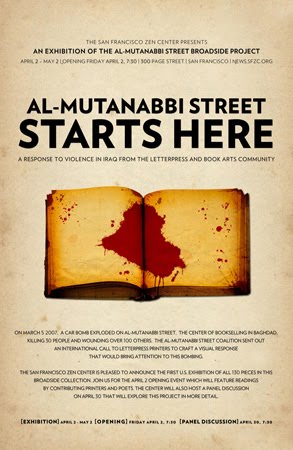
AL-MUTANABBI STREET STARTS HERE (ON FRIDAY)


If you haven’t seen the show of the Al-Mutanabbi Street Broadsides yet, or if you’d like to learn more about Al-Mutanabbi Street, the project, and its future, you should come to the panel discussion “Al-Mutanabbi Street Starts Here” on Friday, April 30th. Along with the panel discussion there will be a screening of the short film "A Candle For The Shabandar Cafe," which is about a cafĂ© that was destroyed in the bombing. All 130 letterpress broadsides are still on display, but the show comes down on May 2, so this may be the last good chance to see them. I will be a member of the panel, as well as:

Grendl Lofkvist (printer)
Celeste Smeland (artist/printmaker)
Tom Ingalls (Graphic Artist)
Felicia Rice (printer)
Beau Beausoleil (poet)

And this is all taking place at the San Francisco Zen Center. I hope to see you there.

Al-Mutanabbi Street Broadside Exhibition
April 2 – May 2
Panel discussion on April 30th at 7:30 PM
300 Page St.
San Francisco
news.sfzc.org

20100426

CURRICULATING (4)

I want to elaborate on the facilities post, particularly in regard to the idea of having a Book Arts program that teaches students how to use production presses: both high-speed letterpress and offset lithography. Why is it important to have this equipment? How is it beneficial for the students?

There are a few reasons why I think it is important to teach this equipment. The first is very practical: learning to use these presses will help students in finding a job after they graduate from school, because these presses are still used commercially (in small studios, generally). With the number of small, commercial letterpress studios still growing, more and more of these jobs will be available. And as I know from experience, being a letterpress printer at a small commercial studio is not a bad way to make a living, especially for someone just out of school. And commercial printing is an education all of its own.

Offset is a bit trickier, as small run shops are moving toward digital presses (should the program have a good digital press as well?). There are a few Book/Print programs that teach offset printing (University of the Arts and Columbia College in Chicago come immediately to mind) and the number of artists who print their own offset books is extremely small (see JAB 25). If offset is going to mean something as a medium, it needs to be used by artists and designers who fully understand its unique capabilities—it needs to be used for more than 4 color reproduction.

Which I think brings us to the more “abstract” reason for integrating this equipment into a Book Arts curriculum: that the use of this equipment enlarges the field of possibilities for artists, and for the art as a whole. It changes the terms of production—quantity and reach expand, without sacrificing the elements of finely tuned control that we expect and demand from “analog” processes. When the terms of production change, the discourse within and around a particular medium changes as well. Letterpress no longer has to be precious, and offset no longer has to be mechanical to the point of absolute transparency. What the processes could mean grows. How they mean becomes observable in a different way. The discourse groans and expands.

Of course, we are basing this whole premise on the larger idea that an educational program in the Book Arts should expand the field. Some might argue (more in the way that they teach and less in what they say) that the job of academic institutions is not to expand the field, but to maintain the (or establish a new) status quo. How can a program be continually expansive? Just by having some fancy equipment?

20100422

COMPOSITION n

“Let us now perform the work of daylight.”

Piet Mondrian, from The New Art—The New Life: The Collected Writings of Piet Mondrian, ed. and trans. by Harry Holtzman and Martin S. James, Boston, 1986.