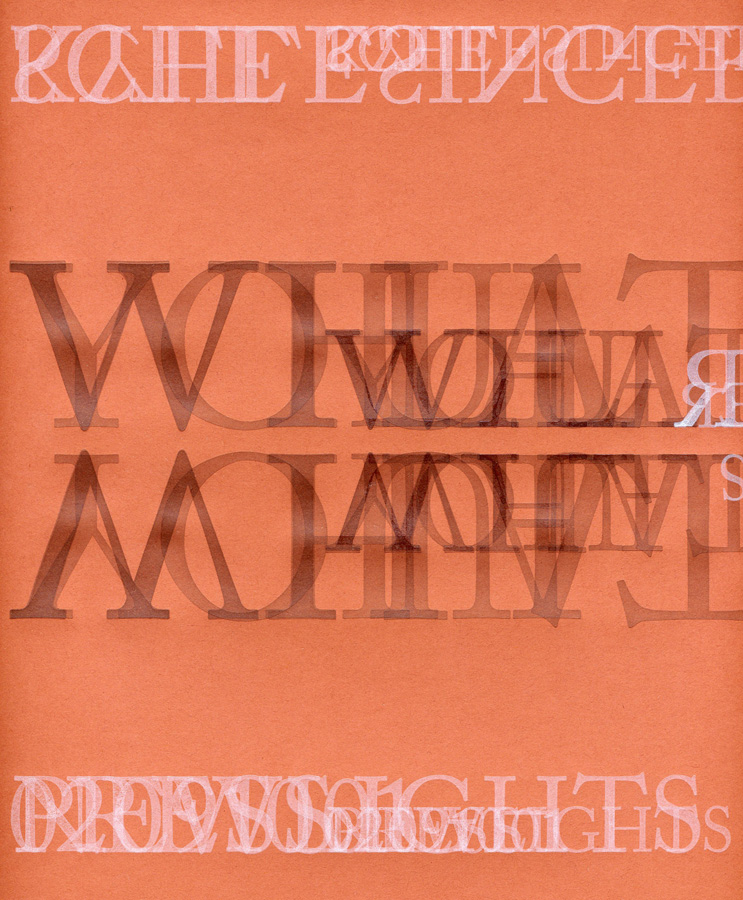
Showing posts with label What You Will. Show all posts

20120611

NOW (NON)LIVE ONLINE: WHAT YOU WILL by KYLE SCHLESINGER

I've been spending a great deal of time with these digital "reprints" lately, and there are a few issues with them that are becoming more apparent—small ones, tiny details—but things that can change the entire experience of reading/viewing the books. Something about verisimilitude. But we’ll save that for later in the week. And now:


Open publication - Free publishing - More artists books

Poems by Kyle Schlesinger
44 pages, double signature pamphlet stitch with folded jacket
4.375” x 8.75” (closed)
Letterpress printed in three colors from photopolymer plates
Edition of 100
All copies are signed by the author
2011

20111128

WHAT YOU WILL


What You Will, a new book of poems by Kyle Schlesinger! It’s done! It’s out! & it wants to live in your home!


Poems by Kyle Schlesinger
44 pages, double signature pamphlet stitch with folded jacket
4.375” x 8.75” (closed)
Letterpress printed in three colors from photopolymer plates
Edition of 100
All copies are signed by the author
2011
$20 (plus shipping)
Out of Print


20111114

WHAT YOU WILL IS COMPLETE


Finally, after nearly 2 years. Now they will be sent to the author, Kyle Schlesinger, so that he can sign them. They will officially be released and available for purchase in exactly two weeks, on Monday, November 28.

20111107

PRODUCTION IS RECEPTION (34): WHAT YOU WILL (20)


Entangled. Now that binding has begun, it’s hard to think about anything else besides getting these books done. They will be finished by the end of the week, even if I move at a moderate pace. After they’re finished, they will all be mailed to Kyle to sign, and then when they come back to me, they will be released and available. Probably in about 2 weeks. At last, at last.


Compiling, collating, stacking, binding. This is one of the strangest parts of the whole activity—when all of those fragments are drawn together into a moving whole. Ostranenie. The book never looks how you dreamt, never looks how you remember. It takes its shape gradually, through folding and sewing, and then through pressing and trimming. It expands, it contracts, is hewn from space and time, plane, line, and point, bending, sagging, twisting, moving. An object in the world, subject to. As light as such. Always almost there, almost done, almost there, almost done, almost there, almost done. And so on. It bends.

20111102

PRODUCTION IS RECEPTION (33): WHAT YOU WILL (19)


Printing is complete. Final count: 202 press runs. & binding has begun.


20111024

PRODUCTION IS RECEPTION (32): WHAT YOU WILL (18)

I have not so much been absent in these past two weeks, as present somewhere else, in the workings of that other press. But I have managed a few things during that time, specifically more press runs on the jackets for What You Will:


Only 10 runs remain.

20110927

PRODUCTION IS RECEPTION (31): WHAT YOU WILL (17)

This will be the last post documenting the layering and building of the covers of Kyle Schlesinger’s What You Will, because them covers are done gloriously done.


This is a good way to preview the book in its entirety, because the book is reprinted, in its entirety & exactly in position, on the cover. You are seeing the entire book collapsed. This is what time looks like.

I am intrigued by the surface of the printed areas, by how the ink and (non)color built up, and by how the edges and impression of the different plates left different marks. There is something in these covers that can be expanded into future books—an approach, an idea, an insistence on the physicality of the printed object. Books are for handling, after all. These covers are like oil paintings that you get to play with, finally.


Only the jackets remain to be printed. Only 24 more runs. It won’t be long now. This is how time stands as a wall against our bending backs.

20110916

PRODUCTION IS RECEPTION (30): WHAT YOU WILL (16)


The image above shows the covers of Kyle Schlesinger’s What You Will as they now stand, to change again tomorrow. The versos now have all of the poems, 12 of them, printed (the white rectangle on the left side). There will be five more plates printed on that side, from the title sequence. & one run of scoring and the covers are complete.

The images below show the jackets with the first two runs on them. Please excuse the colors on these images—the lighting in the studio is awful for photos. The last image is the most accurate, color-wise.


20110823

PRODUCTION IS RECEPTION (28): WHAT YOU WILL (14)


The right half (recto) of the cover of What You Will is complete: 44 runs. 17 remain on the verso. And then 28 on the jacket. Because I am back “on the clock” at the Press at CC, production is being adjusted slightly—I will print the jacket, 1-2 runs per session on weeknights after work, and do the cover, 2 runs per session, on the weekends. The runs on the cover are 4 times as long (2 covers x 2 sides) as the runs on the jacket. So now both pieces will develop simultaneously, and hopefully there will be images of both as they build up.

Long projects like this, with lots of printing, always help me generate new technical ideas as I’m working. Things happen that I did not anticipate, sometimes those things are interesting. The important thing, as always, is to pay attention.


I am intrigued by the surface of the printed areas of these covers. I am also intrigued by the deboss/emboss of the large, “negative” type inside a solid block. The use of multiple impression depths in combination with figure/ground reversals seems promising.

This book was conceptualized and designed (and went into production) when I was still in the Bay Area, when I had no reliable access to lead type. I had to make the book with what I had access to: photopolymer plates. It made sense to me to convert that constraint to an advantage—to make a design that fit with & drove the work and could only be achieved through photopolymer. This is what led me to the transparent, mirrored letters and the “negative” type blocks. This book could not be printed digitally. This book could be printed offset. But then that’s where things like impression and other on-press interventions come in.

I have been asked why I don’t offset print the NewLights books. The answer, at times, is as simple as: because I don’t know how to run an offset press. It’s important to me to be able to participate, actively, in the production of these things. & now, to set these things up so that they require that active participation to function.

20110729

PRODUCTION IS RECEPTION (27): WHAT YOU WILL (13)


The images above show the cover of What You Will where it currently stands, 62 runs deep, with 26 on the left side now, and 36 on the right. Every plate used in the printing of the book is printed on the covers in white, in its exact location on the page, one on top of another. The books will be bound with a double-signature pamphlet stitch, so there are two cover sheets for every book, printed exactly the same on the front and back. So when the covers are folded and wrapped around and into the pages, the rectos of both sides of the cover will have all of the plates from the recto pages of the book, and the versos of the cover will have all of the verso plates of the pages. The layered structure of the entire book will be visible at once, both collapsing and exploding the pages.


Printing right now is very routine: just switching plates, making slight adjustments to the position, and printing long runs (100 books x 2 covers per book x 2 sides per cover = 400 impressions per plate). Yesterday I was reminded of an incident in one my painting classes when I was in art school in Baltimore, an “incident” that at the time was small (a normal critique of work done in class) but looking back from here, that professor, was, in a way, predicting the future….

The first semester of my sophomore year (Fall of 1999, the semester before I learned to print and started the NewLights Press) I was in a painting class that was based loosely around traditional techniques of figure painting in oils (glazing, etc.), but also featured a large amount of independent work. I was in the class mostly because I wanted to work with that professor, who was great. One day we were doing an in-class figure painting from a model. I was working on small, square canvas, and had set up a painting where most of the model was cropped off of the canvas and the majority of the composition was the white wall behind him. Because what I was interested in was painting that wall.

And so I tried to paint the wall (on my canvas), but I really wasn’t trying to paint an image an image of the wall (I thought I was), I was just putting white paint onto the surface of the canvas and enjoying that. The professor stopped me and explained that I wasn’t really painting, in the sense of trying to make a picture, but that I was just “marking time,” making a series of essentially arbitrary brushstrokes on a surface. The only thing being articulated by those strokes was the time it took to make them.

This was before I learned to make books. I thought of myself, more or less, as a painter. I was trying (not really trying) to be a “good” one. I had no idea what that meant. I was 19. I had not yet been pointed to the work of Robert Ryman, though it probably happened soon after this “event,” perhaps because of it:


Robert Ryman, Ledger, Enamelac paint on fiberglass, aluminum and wood, 1982.

Robert Ryman, Series #33 (White), Oil on canvas, 2004.

That professor was pointing out that my engagement with that painting was an engagement with the raw or mundane or technological aspects of the process: making marks on a surface. That was a valid critique from his point-of-view, the point-of-view of the assignment, because we were supposed to be doing a figure painting from life. But sometimes critiques like that open up other doors. And I think that is one of the main things that made this professor good—he didn’t just tell me to stop and get back to the figure, but talked to me about what I was doing, helping me to see something in my approach that I was blind to. [Thank you, Karl.]

So fast forward to yesterday. I was printing, white block after white block. And at some point I stopped, and thought:

Am I just marking time?

And the answer, at least for the moment, seems to be yes and no—yes, marking time, but no, not just marking time. Marking time because the time of the process of printing the book was being articulated on a single surface and distributed across the edition. Marking time because the temporal structure of the book would be legible at once. Not marking time because the surface of the page, and its 2D composition were also being articulated. Not just marking time because that time will be re-inscribed into the here-and-now of the reading of the book, of the reader’s understanding of the book as an object, as a made thing-in-the world.

20110708

PRODUCTION IS RECEPTION (24): WHAT YOU WILL (12)


Printing on Kyle Schlesinger's What You Will has resumed, and has been going strong for the past two weeks. This post is sort of about that, but not really—It's about one of those weird, interesting things that can happen while one is working, those things that one needs to remember to use later. “Happy accidents” is what the kids like to call them. The pictures here show some strange, randomish printing on the tympan of the press. The “accidental matrix” here was a long piece of hair stuck between the quoin and furniture. It was long enough to pick up ink from the rollers and to brush against the tympan while I was printing. The line quality is really lovely, and of course the composition that is built up by the movement of the hair is something I never would or could have done if I had been trying to control it. This makes me wonder: what are the possibilities of a movable or flexible printing matrix, like pieces of hair, or string, or wire, or cloth, or something else?


20101213

PRODUCTION IS RECEPTION (12): WHAT YOU WILL (11)


A nice weekend with some long hours in the studio. Below are some shots of the first stages of printing the black plates on What You Will. It's satisfying, after all this time, to see that pages start taking shape (and this book is all about its pages taking, having, shape).


And a Cautionary Tale
I've discovered one minor drawback to the plastic-backed photopolymer plates: they warp like crazy, if you don't store them properly. If you do store them properly (in a sealed plastic bag, flat, and in the dark) then they will be fine.


These plates were so warped and hardened from gradual light exposure that they wouldn't stick flat to the base, even under pressure from the press. That's a lot of wasted time & money, unnecessary delays, etc., so let this be a lesson. Store your plates properly!


20100601

PRODUCTION IS RECEPTION (11): WHAT YOU WILL (10)

Nothing like a long weekend to get some work done. 20 more runs down. Images of the “tagged” pages below, minus one that I couldn’t find. Will it ever come back? The detail shows the printing of the “opaque white” ink on the black paper (the covers). Letterpress/offset ink that is labeled as opaque is still very transparent at such thin layers. I am trying to take advantage of that fact with these covers, by using the white ink and black paper to make another kind of transparent gray.

The colors got a little weird on these. My apologies.