20120224

PRODUCTION IS RECEPTION (41): AS-OF-NOW UNTITLED (7)

The book is very far along now, ready to go to press. But still there is no title, even this far into it. In fact, I keep forgetting that it needs a title until I write these blog posts. (I always just refer to it as “the JAB book.”) There is no title yet because there is no front matter, no title page, no spine, no cover, etc. So no to place to put a title means no title. Perhaps it is “no title” instead of “untitled.” We’ll see.

The last post about this book talked a bit about the colophon, which has been difficult to write. That difficulty was mostly caused by uncertainty about the form and the length. For awhile I thought that I needed a much longer colophon than I had originally anticipated, and spent days trying to add to it. But then it got too unwieldy, too bloated. So for the sake of the text, of the writing, I reconfigured the form of it. I think the new form (pictured below) is actually much more effective. And the whole thing is shorter, much more “to the point” while still maintaining the “poetics” of the “main” text. Everything always comes together in the end, but it’s important to remain critical and flexible until that moment when it all comes into focus.


Here is some more of the text, from the “end,” but there is no end really, as this thing is just really getting started now:

—what comes next; the world, the world; pushed up and trembling; shabby thing that it is; the morning; and waking; again; here; here; here; here; here; here; like that; just like that; but different this time; this time it’s different; this light; changed; but suspended the same; the color; different now; and thin; congealing; bare; and projected; the objects; the world; the same; lovely just the same; lovely just the same; lovely just the same; lovely just lovely in the light like that; as it changes; as it is suspended; and projected; and above; and folds beneath the hands; always folding; always turning; turning bare and scraping; the text of this; a new scar for every new day; every new day a new scar in this holy book; the surface shimmers, is broken; but there is always this pushing through; always this light; this color; never the same and very rarely different; but it congeals, hopelessly; joyfully in this bursting light; the world is filled with it; unbelievable; it can hold up so much; so much fragility; always there; hanging; about to dream again; about to wake again; the world is filled with it; bare and scraping—

& this is where we can begin, thankfully. The pages of the book turn, turn constantly, like the hands of a clock. The reading of the text is the most subtle, slight turning of the pages. We barely see it. And then when it really happens it happens so quickly. We barely see it. We were asleep after all. And just waking, now, in this new page. But it did not begin here. But it always begins here. We barely see it. We love what we know comes next &

—suffused with the holy work of the morning; unstoppable in the reaching paleness of this light; this home; this page; this work; this home; this page; this work; this home; this page; this work; this home; this page; this work; this home; this page; this work; this home; this page; this work; this home; this page; this work; this home; this page; this work; this home; this page; this work; this home; this page; this work; this joy; this love; this home; this light; this bareness scraping always against the text; this home; these books; these mornings; this morning; this joy; this bursting; this book; this writing; this unbelievable light; never would have thought; this joy; every; every; every; every; every; every; day; love; terror; this joy; this holy work; this holy work; this is the morning; this is the morning; this is the morning; this is how it should be; wants to be; always; this holy morning and this holy work; this pale light and warmth reaching through; this home; this page; this work—

& this is where we can begin, thankfully. The pages of the book turn &

20120220

NOW (NON)LIVE ONLINE: THE INFERNAL METHOD


Open publication - Free publishing - More artists books

Text/object by NewLights Press: Aaron Cohick, et al.
12 pages, no cover, saddle stapled, 7” x 5.5”
Letterpress printed on newsprint, with additional elements added by hand
Edition of 350
2009
Released as part of Issue #3 of Mimeo Mimeo.

20120215

MORE THINGS TO SHARE: DENVER ZINE LIBRARY

The Denver Zine Library is running a fundraising campaign. It’s a library for zines. This is a small, important, importantly small thing. Below are two videos. The first is their intro video, and the second is their 2 week update, just posted to the fundraising page today. And here are some links—one to the fundraising page where you can make a donation, and the other to the Denver Zine Library main site.


20120213

MIMEO MIMEO #6 IS OUT & AVAILABLE, and AN INTERVIEW


Issue number 6 of the great magazine Mimeo Mimeo is out and available for purchase. Here's the official description from the Mimeo Mimeo blog:

Mimeo Mimeo #6: The Poetry Issue will soon be on newsstands everywhere featuring new work by eight poets who have consistently composed quality writing since the golden era of the mimeo revolution. Contributors include Bill Berkson, John Godfrey, Ted Greenwald, Joanne Kyger, Kit Robinson, Rosmarie Waldrop, Lewis Warsh, and Geoffrey Young.

Beat the crowds and have a copy delivered to your door hassle free. Each copy packed and personally addressed with care by the editors of Mimeo Mimeo. Just click on the "Buy" button on the right and select your location. It's as easy as that.

Buy it here.

& I am very honored to be included in Rob McClennan's series of interviews with small press publishers. He asks some good questions. You can read that here. Thanks Rob!

20120208

POEMS & PICTURES AT COLUMBIA COLLEGE CHICAGO


Poems & Pictures: A Renaissance in the Art of the Book (1946-1981)

Opening Reception
Thursday, February 9: 5 - 8 PM


Poems & Pictures features books, paintings, collages, periodicals, and ephemera that explore fundamental relationships between form and content; seeing and reading; writing and drawing; and the extraordinary occasions when these things and activities fuse, introducing a third element.    

Poets, artists, and collaborators in this exhibition include Wallace Berman, Joe Brainard, Robert Creeley, Jim Dine, Philip Guston, Joanne Kyger, Emily McVarish, Karen Randall, Larry Rivers, George Schneeman, and many more [including NewLights!]. Together they share in the common objective of bringing bold new writing into print where commercial presses fear to tread, and to do so with imagination and intelligence. 


Poems & Pictures originated at The Center for Books Arts in New York and is curated by Kyle Schlesinger.

More details here.

20120207

PRODUCTION IS RECEPTION (40): AS-OF-NOW UNTITLED (6)


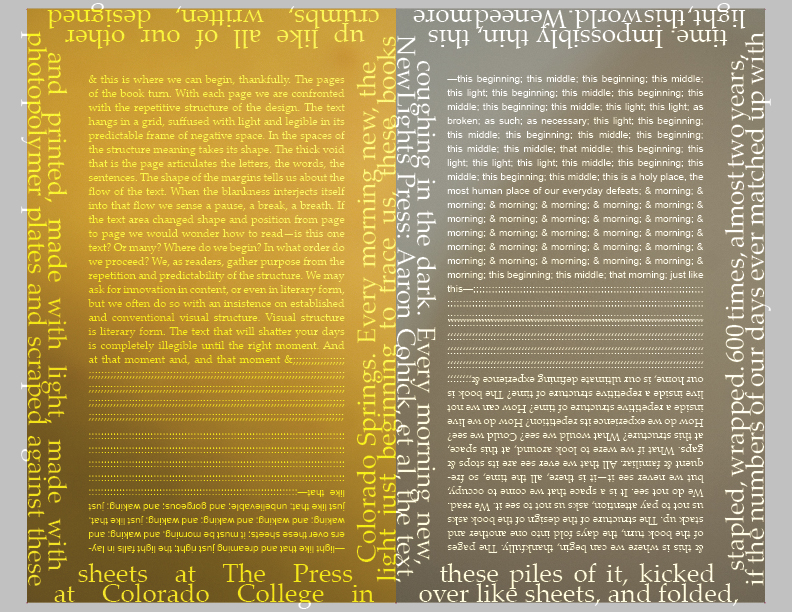
A big challenge in the writing of this new book has been the colophon. Ordinarily NewLights colophons are very simple—just the info that seems important, without too much “ornamentation.” But this one will be a little different, as I want to integrate it with the main text. The book, theoretically, will have no clear beginning or end, no cover, no endsheets, no title page, and no front or back matter. But it needs to have a colophon, particularly because it’s a collaboration, printed partly by other people in another place. It’s important that their work is acknowledged.

The image above shows the current layout for the pages and colophon (sort of). The colophon is the larger text running around the perimeter of the pages. The pages will literally be framed by a description of their own production. I’m not sure if it’s all working yet, either textually or visually. But here’s the newest colophon text. It’s not long enough yet. It doesn’t fit right. But here it is:
It might also begin here. Every book has its edges, its boundaries, tracing its body in the morning. Somehow, like this morning, this book was made. By hand, by machine. By a persistent light in the morning, once barely there, now stronger, now struggling with its fullness. Most often we should just let it sleep. But the light accumulates, answers fitfully, in pieces, layers. These photographs were taken by the author, in the morning, with its light, its edges, its fitful sleep bashful and lying, now standing, in the light. They were built up, printed, layer upon impossibly thin layer (thinner than these pages, these sheets in this crawling winter morning), offset by Brad Freeman and Print Production Fellows Jenna Rodriguez and Claire Sammons. How could these mornings happen in Chicago? The book is always many places, times, stutters. These mornings are everywhere, but accumulated, printed at The Center for Book and Paper Arts at Columbia College Chicago, as an insert for JAB 31. Unbelievable then, how these mornings were quietly made in the rushing of machines. The text happened later, piled up in the days, piled up like all of our other crumbs, written, designed and printed, made with light, made with photopolymer plates and scraped against these sheets at The Press at Colorado College in Colorado Springs. Every morning new, the light just beginning to trace us, these books coughing in the dark. Every morning new, NewLights Press: Aaron Cohick, et al, the text, these piles of it, kicked over like sheets, and folded, stapled, wrapped. 600 times, almost two years, if the numbers of our days ever matched up with time. Impossibly thin, this light, this world. We need more layers, more fullness, here in the bare winter morning. We pull the sheets closer, and the books fall back to stuttering and dreaming. Our days, our homes, our places of repetition, of joy, of new light all the time. We love what we know comes next.

20120203

OFF TO IOWA


To talk with some people about books. Go figure. See you on Monday.

20120201

NOW (NON)LIVE ONLINE: 7:8:1


7 one word poems of 8 letters or less by various authors 
Including contributions from: Lauren Bender, Anselm Berrigan, Aaron Cohick, Jeremy Sigler, Hunter Stabler, Nate Wilson, and John Yau

24 pages, softcover, saddle stapled, 4 ¼” x 9”

Letterpress and screenprinted cover with photocopied text pages

Edition of 100 

2003
$3 – currently unavailable

This is an older book, from 2003, before I really had a clue as to what I was doing but having a good time trying to figure it out. The roughness of this and the other older books has a certain kind of charm, at least for me. But perhaps I’m just getting nostalgic.

You’ll notice at the end of this book that it says “tin woodsman editions” along with “NewLights Press.” Tin woodsman editions was a second imprint that I was using briefly, that was supposed to be for cheap, fast books in large editions. At the time, I think I was thinking of NewLights as making “nicer” books and thus felt the need for a second imprint. Tin woodsman was abandoned when I came to the conclusion that NewLights is and was a press that produces many different kinds of books.

I do like this “one word” idea though, and it may be making a comeback very soon….

20120130

LOCAL-IZING (2)

Speaking of community, I’ve been thinking a lot lately about how to get this blog to include contributions from other people. I’ve always hoped that it could be a resource for others engaged in similar activities, but perhaps it can also be a channel of communication for that community as well. My first thought on how to do this was to do simple profiles of other small presses and makers of artists’ books. But then it came to my attention that someone else is already doing that, has been doing it for awhile, and is probably doing a better job than I would. I haven’t given up on that idea completely, but I need to figure out how to steer it in a different direction.

And then, of course, there could also be interviews. And there will be interviews—in fact, this post is the first one (Really! Keep reading!). I thought it might be interesting to do the interviews with groups of people, asking one question about a particular topic. As usual, I’m doing everything on the fly, in the morning before I go to work, so I haven’t quite refined the system to have received multiple answers that I would post all at once. I’m excited about this first one, so it’s going up now. Here it is: a question about community, directed to Adam Robinson, the proprietor of the great Publishing Genius Press in Baltimore, MD.

NewLights: Publishing Genius is based in Baltimore, MD, and frequently publishes work by Baltimore writers. Does Publishing Genius make it a point to publish work by local writers and artists? And why? And are there other activities around publishing that you see as important for fostering local community?

Adam Robinson: Initially, I didn't have any intention of publishing writers local to my community. In fact, I didn't realize until last year that a significant portion of PGP books were from Baltimoreans (7 out of 18, basically). Then, when I did realize it, it came as no surprise. It made sense, not because Baltimore has a particularly rich literary community (which, as you know, it does), but because I seek out like-minded people, and I become friends with them, and I pay close attention to what my friends do. I do feel like it's one of my goals to promote my community's culture, and interestingly that is another way of expressing myself, personally. By publishing Megan McShea's book (forthcoming), I'm saying, "This is who I am, or what I want to be like." However, does this foster local community? I mean, it bolsters Baltimore's writers outside of the community, but I'm not doing a great deal to get the books into the hands of this city's residents. But one aspect that I think does foster the community, something that you pointed to in your blog post, is bringing in outsiders for the event, and showing them around town. Taking them to the amazing local literary hotspots like Atomic Books and Normals. Introduce them to people by hosting readings and encouraging the exchange of ideas. And not just that, but publishing and reading translations, I think, has been on my mind a lot lately. Because it's an important question: what is a community. There are worlds within worlds. Before I'm a Baltimorean, I think, I'm an artist. That links me with other artists, regardless of location. So I want to know what my fellow art citizens are doing in Spain and Iraq and Singapore. This last bit is perhaps more ethereal than the practicalities influencing your question, it's basically where PGP has been since starting out -- that the literature community takes priority over the municipality -- and yet 40% of the books are by writers who live within 10 miles of me.

Hopefully there will be more of these soon, hopefully they can be presented together. (Of course they can.) If this is a question that you’d be interested in answering, please let me know at newlightspress-AT-gmail-DOT-com.

20120126

LOCAL-IZING (1)

On Monday I had the good fortune to see Ralph Nader speak at Colorado College. It was a great talk, focused on the increasing “corporatization” of American life & politics. (You can watch the whole lecture here.) He didn’t just talk about how bad things are, but gave lots of simple, practical suggestions for people to get involved and begin to change things. So, naturally, I wondered: what can I do, personally? And not just what can I do in terms of getting directly involved with politics/civics, but what can I do, what can the NewLights Press do, to integrate this kind of responsibility and action into daily practice?

One of the ideas that came out in the talk was the idea of “displacement” of large corporations by local businesses and economies—an idea very important to (and already well developed in) the building of more sustainable and responsible agricultural practices. But what is a local economy/ecology for writing and art? What role can small presses play in developing that local culture in a positive way?

One could argue that small presses, by nature of their being small, only participate in a local economy. But when I look at NewLights particularly, it’s quite clear that we haven’t engaged with our home community in a purposeful way in a long time. NewLights has published work by writers from all over the country—most recently by someone from Austin, TX, who was living in NYC when we started the project. J.A. Tyler lives in Fort Collins, CO (about 2 hours away from CO Springs), but publishing a Colorado based writer was an accident—that project began when NewLights was in California, before I knew that I might be moving to Colorado.

NewLights has resided in 4 different states in the last 8 years of its existence. The only place it was rooted in for a significant amount of time was Baltimore, where it began. So I could use the excuse that I’ve moved around too much to invest a lot in a local community. But that’s just an excuse, and now that things seem more permanent, the question returns: what can we do?

And the answer, very simply, perhaps too simply: publish Colorado writers! And when you do that organize readings and other events! Create a space-time for a community to develop! And when you work with a writer or artist from another place, get them out here to do an event, so that there is an exchange with other local economies! It really is that simple. But it’s also not that simple—more questions arise.

If the goal of the press is to publish “the best” writing that we can find (the “best” of our particular area of interest), then are those writers and artists going to necessarily reside in Colorado? And particularly in Colorado Springs? So what does it mean when, as a press, a commitment is made to publishing local work? Does that involve lowering our standards? Or will that commitment allow a space for that local work to grow?

I have a feeling we’ll come back to this….

20120124

NOW (NON)LIVE ONLINE: SOME BEES BY LAUREN BENDER

& another "digital reprint," this one of a NewLights classic, Some Bees, by Lauren Bender. These are erasure poems, written by selectively crossing out words from a dictionary. 


Poems by Lauren Bender
32 pages, softcover, saddle stitched, 8” x 5”

Cover is letterpress printed and hand painted on handmade sisal paper, text pages are laser printed

Edition of 50

2005

Out of Print

20120123

PRODUCTION IS RECEPTION (39): AS-OF-NOW UNTITLED (5)

Or maybe like this, just better, not as sloppy: 


20120116

PRODUCTION IS RECEPTION (38): AS-OF-NOW UNTITLED (4)

Still working on refining the text for the next book. Lately I’ve been thinking of it as an unpacking of the book as a domestic object, or a domestic space. The repetitive structure of time & duration and the repetitive structure of the book. Here’s some more text:

& this is where we can begin, thankfully. The pages of the book turn. With each page we are confronted with the repetitive structure of the design. The text hangs in a grid, suffused with light and legible in its predictable frame of negative space. In the spaces of the structure meaning takes its shape. The thick void that is the page articulates the letters, the words, the sentences. The shape of the margins tells us about the flow of the text. When the blankness interjects itself into that flow we sense a pause, a break, a breath. If the text area changed shape and position from page to page we would wonder how to read—is this one text? Or many? Where do we begin? In what order do we proceed? We, as readers, gather purpose from the repetition and predictability of the structure. We may ask for innovation in content, or even in literary form, but we often do so with an insistence on established and conventional visual structure. Visual structure is literary form. The text that will shatter your days is completely illegible until the right moment. And at that moment and, and that moment &

—light like that and dreaming just right; the light falls in layers over these sheets; it must be morning, and waking; and waking; and waking; and waking; and waking; just like that, just like that; unbelievable; and gorgeous; and waking; just like that—

—this beginning; this middle; this beginning; this middle; this light; this beginning; this middle; this beginning; this middle; this beginning; this middle; this light; this light; as broken; as such; as necessary; this light; this beginning; this middle; this beginning; this middle; this beginning; this middle; this middle; that middle; this beginning; this light; this light; this light; this middle; this beginning; this middle; this beginning; this middle; this is a holy place, the most human place of our everyday defeats; & morning; & morning; & morning; & morning; & morning; & morning; & morning; & morning; & morning; & morning; & morning; & morning; & morning; & morning; & morning; & morning; & morning; & morning; & morning; & morning; & morning; & morning; & morning; & morning; & morning; & morning; & morning; this beginning; this middle; that morning; just like this—


& this is where we can begin, thankfully. The pages of the book turn, the days fold into one another and stack up. The structure of the design of the book asks us not to pay attention, asks us not to see it. We read. We do not see. It is a space that we come to occupy, but we never see it—it is there, all the time, so frequent & familiar. All that we ever see are its stops & gaps. What if we were to look around, at this space, at this structure? What would we see? Could we see? How do we experience its repetition? How do we live inside a repetitive structure of time? How can we not live inside a repetitive structure of time? The book is our home, is our ultimate defining experience &

20120113

PLAN B

Spent the morning working on the PDF for the digital version of The Infernal Method, only to realize when I got to the end that all of the images had been converted to grayscale (for another project). Alas, it looks like re-scanning will be necessary before that goes up on the web. In the meantime, you can’t go wrong with a Hennessy Youngman video, this one is about Damien Hirst:

20120111

GOOD YEAR

6:46 AM on a Wednesday morning and it feels like snow outside, and the fact that it’s 2012 is beginning to sink in. That familiar feeling that it’s time to get things together and move ahead. I’m back now, back at home, back at work. What now?

The College Book Art Association conference was wonderful, as always—great people, thoughtful presentations, interesting and fun conversations. I always wish those things weren’t so short.

There are not very many copies of What You Will left. It’s always so elating and so sad to see them go. But a book’s got to live its life....

What now? The next project is an artists’ book insert in the next issue of JAB. The offset/letterpress book mentioned in some earlier posts. The offset portions are done, beautiful, and here in CO in stacks and boxes, waiting patiently. And then after that there is The Heads, a book of poems by Justin Sirois, and an as-of-yet-undetermined book with Divya Victor. And who knows what else. The usual, I suppose. But what that is—who knows what else.

Will 2012 be a good year? I think we can make that happen. It’s the only reasonable thing to do.

20120102

HERE & BACK AGAIN


& tomorrow it’s off to the CA, for the College Book Art Association conference. Below is an excerpt from the talk I’ll be giving with Mr. Kyle Schlesinger:

Reading is an experience that unfolds in time—the letters build up into words, the words into sentences, and the sentences into a text. That text is at once continuous and fractured. We see it as a line, moving relentlessly from the beginning to the end, but that line is precarious—shot through with cracks, fissures, breaks, white space. The line is an accumulation of fragments. The line is an accumulation of voids. The largest gaps occur in the transition from page to page, through the gutter or around the fore-edge. These are the crucial non-spaces of reading, when the technology of the book rushes up to meet our attention, when our conception of time asserts its artificiality; yet we, as readers, steadfastly ignore it. The lines of text and the blocks of the pages divide and spatialize time—sometimes arbitrarily, always artificially. Artificially because we don’t read like that, we don’t experience books in the way that the things themselves like to imply—in a straight line of perfectly divisible units in strict sequence. The text does not pass by our fixed viewpoint like the frames of a film. We read, we stop reading, we get distracted, we pet the cat, we back up, we start again, we read, we start to fall asleep, it’s a little warm in here, we read, we stop, we read, did you remember to?..., we flip to the end of the chapter to look at an endnote, we read, we stop, a word or phrase reminds us of something, we read, it’s time to eat, we grab a bookmark and wedge it into the space of the gutter, we close the book and now it’s all fore-edge again, now we’re back at the beginning. We walk away. We come back hours later. We walk away. We come back days later. We walk away. We come back years later. The text does not change, but it’s a different book every time we pick it up.

20111226

POSTING WILL BE EVEN MORE ERRATIC


for the next week. Hitting the road this morning and heading back to the PA. We'll be back to it (at least for a bit) on the first.

20111221

LIMIT TEST (5)

Recently I received an email from a friend, in reference to these “Limit Test” blog posts, where he asked me what I thought about the idea of editions and POD (print-on-demand) and ebooks. Are they the unlimited edition? Or does the idea of the edition no longer apply?

Those are interesting questions. The main thread of these posts has been about physical book-objects and their production, but this is an interesting idea that is worth pausing and considering. Does new technology provide an avenue for rethinking the edition?

POD books are set up so that once designed, they sit on a server somewhere, always available, and when someone orders one, a copy is printed, bound, and sent to the buyer. The advantages of this are obvious. But is that an unlimited edition? Is it really any different from a book mass-produced in an “unlimited edition” that goes through multiple printings, theoretically as many as it can until no one ever wants to buy a copy again? Is POD different because you can produce a single copy at a time, instead of thousands? Or is that just a question of scale? POD could also be used to produce unique books….

And then ebooks. Does the fact that they are not physical objects, but digital objects, exactly and endlessly repeatable, mean that the concept of the edition does not apply? One could, in theory, produce a limited edition ebook. There could be one master file from which x number of copies would be made, and all of those copies could have code inserted that would prevent them from being copied again. Or something to that effect. Someone will try this at some point, if they haven’t already. (And then there’s William Gibson’s Agrippa (a book of the dead).)

But what about an ebook in its (now) normal, infinitely downloadable state? Edition or not? One answer: it’s not a real thing, so the idea of the edition does not apply. That answer doesn’t quite work, because if an ebook could be made in a limited edition, then the idea does apply, whether it’s used or not.

Another answer: it’s the same as POD, the same as a mass-produced book that undergoes multiple printings. It is an edition, the closest thing that we’ve developed to the “unlimited edition.”

Maybe “unlimited edition” isn’t the right term. What about “not-limited edition” or “open edition?” As discussed in earlier post “unlimited” and “not-limited” editions are paradoxical terms. So maybe we need to throw them out all together—maybe there is no limit, no edition. An ebook that is not editioned is not limited. Producing multiple copies is not synonymous with “editioning”—which inherently implies a limit.

We can produce an object in multiple without “editioning” it?! What a relief! Thank you, ebooks!

20111216

LIMIT TEST (4)

This post is speculative in nature, a loosely connected brainstorming going off of the question at the end of the last post: What if the edition is not conceived in terms of a constraint at all, but as the generative prompt for the piece? (Side note: Are a “constraint” and “generative prompt” two different things?)

One example put forth in a much earlier post was the idea of a time-based edition: an edition consists of how ever many copies can be produced within a certain amount of time. And then the question: do just finished, “good” copies count, or does everything made within that time count? Do the traditional rules of editioning still apply?

[Thinking about more ideas, a bunch of possible ways to determine the number of edition come to mind: essentially random or found number systems. But that approach just limits the number. What I like about the time-based idea is that is has would influence how the object is produced and how the edition is selected at the end.]

The edition as a concept is interesting in the sense that it defines a “single” object as existing in multiple, both one and many. And not the theoretical multiple of the infinitely reproducible, but a multiplicity that can be defined, that actually exists simultaneously.

What if one counted number of images made instead of objects produced? And the entire edition was collapsed onto a single sheet of paper? (Like a Warhol “painting?”) What if the edition immediately displayed its variance?

What if the edition comprised every print that could be made until the matrix is destroyed through use? Or what about every print made after the matrix breaks down?

What if the edition contained every print that didn’t match the master of B.A.T.?

What if the print initially occurs as a single matrix printed on a giant piece of paper, that is then divided up later? What would determine those divisions?

What if atmospheric or situational variables were combined to produce the parameters of a variant edition? Ex: the amount of people in a given space, what the temperature is in that space, versus the temperature outside, might determine what colors or pieces are used on a particular copy of a single print. The “print” is an open-ended act that incorporates its own time and situation into its making.

This is from the colophons of the NewLights Press DIY series: “This is book number n in an edition whose limits will be determined by practical use and interest.”

20111214

LIMIT TEST (3)

The NewLights Press makes limited edition books. Those limits are determined by two things: 1) the amount of books that we can afford to make—financially, temporally, spatially, emotionally, spiritually; and 2) the number of books that we think will find a home eventually—the number that we can expect to sell/trade/give away. The size of the edition is the maximum number of copies that those two constraints allow. Preciousness or scarcity is something to be avoided. The NewLights Press does not make limited edition books. The NewLights Press makes books in small editions.

(Small, tiny even, when compared to mass production. But on the larger side when compared with other people & presses making books by hand.)

The NewLights Press makes books in small editions, and does not do reprints. No matter how fast that first run sells out. Again, this is not about preciousness or scarcity. It is mostly about the fact there just isn’t enough time to reprint the books—let’s do a new one instead. Let’s do a better one, let’s make the next book.

Limits on an edition are a practical necessity. Let’s not pretend otherwise.

Are there ways in which the edition can be re-thought, re-deployed, re-made, re-produced? If the edition is considered abstractly, as a constraint or framework, how can we play with it? What if the edition is not a pre-determined constraint on the number of copies, but a pre-determined constraint that interacts with the process of production to make a certain number of copies? What if the edition is limited by time? Space? The weather? The text? Another text? The financial markets? The unemployment rate? What if the edition is not conceived in terms of a constraint at all, but as the generative prompt for the piece?

20111212

LIMIT TEST (2)


In some ways the unlimited edition is a paradox. There can never be an infinite number of copies of a particular book at any one time. The edition is only theoretically unlimited, through the potential of more & more reprints. But those will only last as long as the market for the book does. The demand, ultimately, will determine the supply.

So every edition, in one way or another, is limited.

The difference between the limited and unlimited edition is: 1) how they are conceived of at the outset, and 2) how they are expected or made to function in the world. In a limited edition, the book/object is made in an edition of x number of copies, and then that’s it—no more, no less. No matter how fast or slow they sell. The status of the limited edition is fixed, generally present and filled at the time of production. The limited edition avoids excess. The limited edition is also based on truth/trust. Its value is dependent on its scarcity. If it’s found that there are more copies on the market than are claimed by the object itself, the price and credit of the maker or publisher will shrivel together. The artificial destruction of the book/object, while it may increase the price, will also destroy the credit of the maker/destroyer. The limited edition is a cold, merciless act accepted in good faith in a cold, merciless world.

In an unlimited edition, the book/object is made in an edition of x number of copies, and will be printed again & again & again & again if there is thought to be a market. But the unlimited edition could also only exist in 5 or 100 copies as well. The status of the (unlimited) edition is contingent, tied to the world & its whims. The unlimited edition is only unlimited while the book is in print. If a book is in print, it is simultaneously stalled in, and caught up in, the process of production. The book in print is the book eternal, waiting forever to be finished.

The unlimited edition is eternally threatened. The edition could actually shrink, if the books remain unsold and are pulped. Most mass-market, unlimited edition books face this fate. When the book goes out of print, its edition can become severely limited, but often its value does not increase. The book out of print is the book untouchable, both scarce and forgotten.

Is it better then, to limit the edition at the start, and avoid the slaughter? Or is the possibility of infinity worth the gamble?

20111209

LIMIT TEST (1)


Looking through the Internet the other day, I came upon this (via Printeresting):
http://blog.art21.org/2011/12/06/bound-municipal-de-futbol/

It’s the first post on the new “artists’ books” column on the Art:21 Blog. The intent here is not to critique the book or the post, but to use a brief part of it to talk about something else—the idea of the limited edition.

The Art:21 post mentions that the book "was printed as a limited edition of 1000” My first thought, when reading that, was well, that’s not really a limited edition. 1000 copies seems like mass production, compared to the scale that NewLights and many other book artists and small presses are working at. But 1000 is a limit (assuming they don’t reprint), however high it may seem. So one could, theoretically, have a limited edition of 10,000 or even 1,000,000. Is there a cut-off point on the number that takes a book from a “limited edition” to a “mass-produced object that only happened to go through one printing?” Are mass-market books that only go through one or two printings, by default, a “limited edition?” What is the purpose of a limited edition anyway?

To begin, we’ll start with this excerpt from an interview contained in Hanging Quotes: Talking Book Arts, Typography & Poetry, by Alastair Johnston. The interview is listed in the book as being with Sandra Kirshenbaum, but is, actually, her interviewing the author of the book, Alastair Johnston. Anyway, here are Alastair’s thoughts, circa 1991:
Alastair Johnston: […] I hate the term “fine limited edition” book.
Sandra Kirshenbaum: Oh, you hate it. Then why did you produce one? [laughs]
AMJ: Uh…
SK: It’s a joke, it isn’t really fine?
AMJ: No, it is a fine, limited edition book. I produced it because, in order to use the best possible materials in the book and because of the nature of the binding, which takes forty minutes a copy, I could only produce, realistically, a hundred to a hundred twenty-five copies. If I manage to sell out the edition, I will reprint it. But to me, the notion of a limited edition is anathema. I believe in unlimited editions because that’s what publishing is—getting a text out into the world. Having something so expensive or so exclusive that only a few people have it appeals to the worst kind of snobbery and the commodification of the book. It takes it out of the realm of information, which is what a book is, and puts it into the realm of collectability, which renders it as useless as a 1937 Edsel.
SK: So what you’re saying is that limitation per se is not a desirable trait in a book, only the natural limitation by a factor such as the amount of handwork or even the restriction of available funds.
AMJ: Right.
SK: But if you carry that idea to the logical extension, then isn’t it sort of antithetical for you to deliberately choose methods and materials that will result in limitation and exclusivity, snobbery and all the rest?
AMJ: Well, I’ve actually had a change of heart in recent years. Initially, when I started publishing, I would use cheap materials, of which the main single cost is paper and binding. And I would do books on the cheapest decent paper and do big editions, and try to get them out in the marketplace for under ten dollars. And people would ignore them. Generally, at that level, you’re trying to compete with the trade publishers. You also have distribution problems. And I began to realize that there was no point in putting up all that money and doing a thousand copies of the book if I only sold two hundred. So, therefore, why not spend the same amount of money and do fewer copies and charge a more realistic price for it. I’m still trying to make it affordable […] [1]

So that’s somewhere to start. To be continued.


1. Alastair Johnston, Hanging Quotes: Talking Book Arts, Typography & Poetry, (Austin: Cuneiform Press, 2011), 143-4.

20111207

PRODUCTION IS RECEPTION (37): AS-OF-NOW UNTITLED (3)

The book continues to take shape. Yesterday I found out that I have more time than I had initially thought. So now it can be really shaped, shaped well. I want to really write this one, construct the text of this one. But these things, of course, take time, take it away, away. The base layer of the text is there, so now it’s a matter of starting to insert it into its contexts, it spaces, its form, and seeing what happens. And more shaping as a physical thing. And more shaping as a textual thing. And at some point the light will hit it just right—


[…]

& this is where we can begin, thankfully. The pages of the book turn, and in them we recognize our own days, each one folding over the one before. The space between them is essentially a non-space—the fold of the gutter, the impossibly thin fore-edge—these are the dreaming spaces of the book, the times when text and pages sleep and pass into the next day. If only we could always breathe so calmly. The book is our ideal self, our ideal time, perfect and uneventful, artfully arranged and bursting with light and meaning. Our lives, unfortunately, are chaos, overwhelming fragility, no meaning beyond the raw and gorgeous fact of what is &

—light again, again; in the creaking, stirring; movement begins; again; another morning; like the last; but better, always better; the raw and gorgeous fact of what is; the light, the window, the bed, the warmth, the cold, the creaking and stirring of bodies to movement; suspended in the air; stripped to the bones; exposed to the elements of the morning; suspended; hanging; above; on top; and pushing; pushing through; this terrifying machine begins again; again; this ascent; and hovering; above; and exposed; the cold; the warmth; this light against these objects; raw and gorgeous; this paleness in the air; it moves, barely; bare; the windows covered; still dreaming; still suffused with sleep; with paleness in the morning; against these piles of days; now slight, now slightly stirring; the past is there, but gone; gone; bare and now moving away; bare and now huddling close; to the warmth; the warmth exposed to the cold; this light; fantastic and soft; clutching and pushing; suspended; bare and scraping; this clerestory; constant in its explosions; this clerestory, suffused with light and meaning—

& this is where we can begin, thankfully. The pages of the book turn, and in them we feel a ghost image of our own days—an image flattened, thin, tattered, and marred with frantic scribblings. The book, always empty, always pointing away, like a window or a dream, reminds us of the fullness of our days. They both repeat, but these things in which we live, chaotic as they may be, are thick and heavy, a volume to each sagging page. The book is our phantom self, a fragile extension of our time-soaked consciousness back into our object-laden world. We use it as a lens, a filter, to view our own duration. But it will never supplant the breath, the heartbeat, the raging silence of our mornings. The book is lovely, but it is not love. For it we feel nothing but sadness—shabby, sagging thing that it is &

—the window, the mirror, the door; closed and secure; bashful; the blushing of the light; uneven; pushed to one side; pushing; suspended; that paleness exposed in the pushing of the morning; gorgeous; white and brown and blue and gray and white and cold; the light; this shabby entreaty; this breath; again; again; everyday; this heartbeat; quickens; this is terror; love; exposed to the raw light; a string of windows; a string of days; a thread of text intertwined with pale legs in the morning; text bare and scraping; worship; worship bare and scraping; this clerestory, this scriptorium; another day’s dream is written in pale ink and paper, this light on these objects; immaculate; the constant scriptorium; the writing of trembling pages; white and warm; the constant scriptorium; these are days, already turning; always turning; there is no stopping, no going back; just pushing further into the light; shabby thing that it is; the ceiling; the floor; illuminated; illuminated again; and shaking; and shaking; and shaking; the cold; the cold exposed; the cold bare and scraping; against warm sides; ribs and spines; folding—

[…]


20111205

THANK YOU

We will be back to our regular erratic blogramming soon, but first I just wanted to thank everyone for the support, compliments, and kindnesses last week. It was our strongest release-week yet in terms of sales (just about half the edition). But even better than that was all of the communication, with friends both old and new, that surrounded the release. It’s always so enjoyable to be a part of the swirling world once again. Distribution, and the creation of a community through that, is definitely one of the most fun and most important parts of this endeavor.

Here is a nice, thoughtful review of What You Will by Michael Cross, on his blog, The Disinhibitor. Michael is a poet, editor, printer, and publisher from Oakland, CA. & he’s a really smart guy.

& I think we’ll end with a pre-viewing of the next book. The offset pages came in the mail last week:


20111128

WHAT YOU WILL


What You Will, a new book of poems by Kyle Schlesinger! It’s done! It’s out! & it wants to live in your home!


Poems by Kyle Schlesinger
44 pages, double signature pamphlet stitch with folded jacket
4.375” x 8.75” (closed)
Letterpress printed in three colors from photopolymer plates
Edition of 100
All copies are signed by the author
2011
$20 (plus shipping)
Out of Print


20111121

PRODUCTION IS RECEPTION (36): AS-OF-NOW UNTITLED (2)

Still no title. I think it will probably have to wait until the end. The writing began in earnest in over the weekend, finally, and as this long weekend approaches, maybe there will be significant progress. What follows is the middle of the in-progress draft, two braided threads of text:

[…]

& it can cut deeply & it will be impossible to put it back together again; you can never read the same book twice, you can never go home; time passes; every piece of light is brand new in the unstoppable wave of time; & your hands are hopelessly wounded, scrawled with characters, words, gestures, trembling; terrifying machines in the terrifying light; try and try, your hands will never arrest the book in time; all you can do is bleed &

—a morning with folds, fast heartbeats, folds, and joy; joyful light shining through this glass, this stain; it is the morning, a blemish, a blush; the already scarred face of a new day; gorgeous in the light and twisted like that; red like that; read like that; brown, white, blue, yellow, white; and sheets turning folding; waking in the wake of this light; this day; this light; this day; this light; this day; this light; always new in every repetitive push; this terrifying machine; this time; this day; this light; turning and the light pushes through, awkward, groaning, fumbling, the light passes bashfully; this morning; stripped down to thick & bright, this white gorgeous in the way that it is read; never a sight as such in darkness; never a site as such in darkness; this is joy; this morning; this sight; this is sight; and waking; this morning; made; this light; unmade; folds; the mechanics of these things are incredible; movement, the way movement happens; always new; this day; this light; as such; thick & hanging, everywhere; like that; just like that—

& this is the ultimate measure of time &

—this is where we can begin, thankfully;
[…]

I spent some time playing around with different structural conventions, on how to break the phrases in way different from the “natural” sentence. I don’t know if this solution will be the one actually used, but we’ll see—I do like the rhythm. I’ve also been thinking about the punctuation conventions of early manuscripts, before the rules of punctuation had solidified at all.

And the “normal” text is written only using “you” and “it” as pronouns, while the italicized text is only written using “it.” Very simple structural choices or exclusions like those can help to build very strange texts.

20111118

DON’T DETERMINE ON ME


The following excerpt is from the article “The State of the Book: A Conversation,” by Johanna Drucker and Buzz Spector, which is in the printed Printeresting edition of The California Printmaker (the journal of The California Society of Printmakers), p. 20. [Ed. Note: Totally worth buying and reading and owning.] This particular part is Johanna Drucker:
But as we shift towards the multi-platform possibilities that the current media environment offers, what changes will it make to our work? I find it very useful to use all media for their distinct capacities—aesthetic, production, distribution, affordability, etc.—but know […] that media only offer opportunity, they don’t determine anything. As I’ve said many times, the technical ability to produce avant-garde typography (i.e. Futurist and Dada compositions) was present in Gutenberg’s shop. The cultural disposition towards such innovation did not exist. Such work could not be conceived. Sure, shaped poetry has a long history, into antiquity, and all written language makes use of graphic affordances, but mixed font, diagonal, radically cut-up typographic work has as much to do with the bombardment of the senses in urban spaces by polyglot and multi-modal communications in verbal forms (radio, posters, newspapers, journals, advertising, film) as with technical innovation. [emphasis added]
I think that the point that Drucker is trying to make here is an important one: that any media in and of itself has no “natural” state, no “natural” progression that the work in that media inevitably follows. “Media only offer opportunity” to human and institutional agents. This is also the whole point of The Nature of the Book, by Adrian Johns, which talks about how everything we take for granted about books & print was not always so, and were constructed over time, differently in different places, through an extraordinarily complex set of conversations, arguments, laws, and practices. To cite a modern example, the Internet is not inherently and naturally “democratic,” and could/can/is be used for insidious and/or overt social control—all in the name of justice, of course.

What does this mean for us, now, in the opening stages of a possible shift from print to electronic text? It means that we shouldn’t let corporate/media/money interests tell us what the future is—it means that we must share in the active shaping of it. Which is why this is such an exciting time to be doing all of this writing, publishing, making, designing, shaping, becoming, occupying, sharing, talking…

20111116

AFTER MATH

It’s always a strange thing to finish a large project. Suddenly an absence, and not-knowing creeps back in, nestles under the covers. But there is rest. Hopefully today What You Will will arrive in Austin, and I can hear what the author thinks. We’ll see.

Ordinarily we would release the book as soon as it’s finished. With this one we’re waiting a bit, mostly because of Thanksgiving. (The release will be Monday, Nov. 28.) Which is good, because it will give us more time to coordinate the release and promotion. And promotion is something that NewLights need to work on, as noted in some earlier posts. And also distribution logistics—I’m still not happy with how shipping options are set up with our PayPal buttons. But there is time to work all of that out, and it’s not necessarily interesting to anyone but me.

This morning I was thinking about a “book trailer,” which is something that I’ve seen other small presses doing, for at least a couple of years (maybe more?) now. Usually they’re videos. We’re not really set up for video production, so maybe if we do a trailer it will be in digital book form, images and text from the finished piece, plus images and text from the process of making it.

But perhaps the most important question at this point is, “Now what?” Not in the sense of what book is coming next, because the publishing schedule is set for at least the next year, but in terms of what NewLights can be/do. Where do we take things from here? That question, of course, is always there, but sometimes it is repressed by a series of tasks-at-hand, only to come rushing back in every quiet moment, hanging, a filter through which all of our breath gathers, a window through which all of this sunlight passes. A new day shivers. It is winter, the air around us is cold. And so warmth blooms in action.

20111114

WHAT YOU WILL IS COMPLETE


Finally, after nearly 2 years. Now they will be sent to the author, Kyle Schlesinger, so that he can sign them. They will officially be released and available for purchase in exactly two weeks, on Monday, November 28.