skip to main |
skip to sidebar
But what about the accessibility of content? Is affordability enough to make an artwork “democratic?” Or does it need to be, as both Lippard and Drucker imply, also “accessible” in the sense of “easily understood or appreciated?” This is a difficult question—political, aesthetic, social, economic. But it is a question worth asking, and, of course, at least trying to answer. The following is from Craig Dworkin’s Reading the Illegible:[…] The politics of literature, accordingly, is no less fraught. In the narrow sense of “politics,” poems are quite simply not efficacious. At best, they may present models from which readers can extrapolate modes of thought or behavior which can be translated into other contexts and systems. To the degree that poems affect a reader’s understanding of language, they have the potential to alter all of those extraliterary relationships that also involve language; but they do not directly influence electoral politics, or feed the hungry, or soften blows. […]
The very importance of political issues, in fact, demands a more sophisticated reading practice. Both Jed Rasula and Bruce Andrews have suggested the requirements for such readings […]. Following Rasula’s terminology […] one might differentiate between the politics through, the politics in, and the politics of the poem. The politics through the poem would, accordingly, be politics in the narrow sense [described above]: essentially false leads, though perhaps occasionally and collaterally achieved by certain rallying songs or the poetic ornaments accompanying speeches. The politics in the poem would indicate Pound’s discussion of Mussolini, say, or Adrienne Rich’s feminist thematics. […] the politics of the poem: what is signified by its form, enacted by its structures, implicit in its philosophy of language, how it positions its reader, and a range of questions relating to the poem as a material object—how it was produced, distributed, exchanged. Or in Bruce Andrews’s terms: “writing as politics, not writing about politics.” […] To extend one’s reading to the politics of the poem is a prerequisite for a more significantly and fully political or ethical reading, and to that end I want to insist throughout this book on a radical formalism. I adapt the term from Andrews’s definition of a “radical praxis,” which “involves the rigors of formal celebration, a playful infidelity, a certain illegibility within the legible: an infinitizing, a wide-open exuberance, a perpetual motion machine, a transgression.” A sufficiently radical formalism pursues the closest of close readings in the service of political questions, rather than to their exclusion. At the same time, it refuses to consider the poem as a realm separate from politics, even as it focuses on “the poem itself.” It is a matter, quite simply, of being true to form. As a ‘pataphysical investigation of minute particulars, radical formalisms hew to the concrete. Where “concrete” is what the street is made of. […] [1]
That idea, of a “radical formalism” frames where I want to begin with this question of content and accessibility, or of form and accessibility, as the case may be. I feel like this can be a productive discussion—more soon.1. Craig Dworkin, Reading the Illegible, (Evanston: Northwestern University Press, 2003), 4-5.
In the quotes used in the post below, both Johanna Drucker and Lucy Lippard point out that artists’ books “failed” as a democratic multiple not because they weren’t affordable, but because they weren’t accessible in terms of content. The “general public” could not understand the books. So then there are two kinds of accessibility we’re talking about here, and we need to be clear. We will call economic accessibility “affordability,” and we will call content accessibility just “accessibility.”Affordability is definitely an issue, and though it can often be dealt with in concrete economic terms (this book cost this much money to make, so therefore the price is this much) those terms, strict as they are, don’t always give a result acceptable to the artist and/or the market. The books might end up costing more to make than people will pay for them, so the price has to be dropped in order to sell them. Or they might cost more to make than the artist/publisher wants to sell them for, and so the prices get lowered, oftentimes resulting in a non-existent or very low compensation for the time involved in making the book. The NewLights low prices are a result of both those things. The books often circulate within a “literary” market, where small, handmade books are generally cheaper than trade books. Most people won’t buy them if they’re too expensive. So in order to get them to be bought by people (not just by collecting institutions) the price needs to be at a place that is easy to accept, that matches up with the audience’s idea of how much the books should cost. This is why I maintain a commitment to making books that will sell for $20 or less (not all the NewLights books, but most).So if the artist/publisher wants to keep their work affordable they have two basic options: 1) figure out how to make making the work cheaper and less time-consuming. Depending on the kind of work this could compromise it considerably. 2) Subsidize production by having another job. This can compromise the work by placing serious drains on the artist’s time & energy. Having a second job (which one is the “real” job?) is probably the most common solution, the one that I have used since I finished my BFA. It is fairly effective—as long as one has lots of energy, determination, and focus. Most working artists do, because if they did not, the work just wouldn’t get made, whether they can afford it or not.The trick is, I think, to make sure that the production-pricing-selling process doesn’t lock the artist into a cycle of diminishing returns, where each piece becomes more difficult to make than the last. Not only will that slowly bankrupt the artist, but it will also eat away at their spirit, causing them to burn out, pack it in, and sometimes stop making work period. That needs to be avoided, at all costs.
Success in art usually comes through tenacity. I will try not to flinch.From the post 2 days ago:[…] I wonder about the idea of “reception,” about democratic multiples, un-democratic multiples, and un-multiplied multiples. I wonder about accessibility, both economic and aesthetic/conceptual. What kind of accessibility, economic or aesthetic/conceptual, or both, qualifies a piece as “democratic?” I wonder about legibility, and if that is different from accessibility. […]Of course everything is related, and the current re-evaluation of the NewLights Press is meshed with larger theoretical-aesthetic-social concerns about books and bookmaking in general. So we are back to the “democratic multiple,” we are back to the form-content-production-reception model. The articulation of “reception,” and how it is addressed, embodied, and activated through the work remains one of the most difficult (productive) problems. We will start by pulling at this term “democratic,” the words pulled along in its wake (“accessible” and “legible”) and some discussion from some of the canonical literature.democracy n. a form of government in which the people have a voice in the exercise of power, typically through elected representatives. A state governed in such a way. Control of a group by the majority of its members.
ORIGIN C16: from Fr. democratie, via late L. from Gk demokratia, from demos ‘the people’ + -kratia ‘power, rule’.
democratic adj. of, relating to, or supporting democracy. Egalitarian. [1]
[…] Artists’ books have existed since early in the century but as a named phenomenon they surfaced with conceptual art in the sixties, part of a broad, if naïve, quasi-political resistance to the extreme commodification of artwork and artists. Accessibility and some sort of function were an assumed part of their raison d’etre. Still, despite sincere avowals of populist intent, there was little understanding of the fact that the accessibility of the cheap, portable form did not carry over to that of the contents—a basic problem in all of the avant-garde’s tentative moves towards democratization in the sixties and early seventies. The New York art world was so locked into formal concerns (even those of us who spent a lot of time resisting them) that we failed to realize that, however neat the package, when the book was opened by a potential buyer from “the broader audience” and he or she was baffled, it went back on the rack. […] [2]
[…] Undeniably true as both the historical facts and critical conceptions expressed in these lines may be, they have given rise […] to certain misconceptions or myths about artists’ books. The first of these is that it is necessary for artists’ books to be inexpensive works in unnumbered or unlimited editions. The second is that they should be produced in a small format, through commercial means. The third is that this produces a democratic artform—one whose democracy resides in its affordability rather than in the accessibility of its content. […] [3]
access n. 1 the means or opportunity to approach or enter a place. The right or opportunity to use something or see someone. 2 retrieval of information stored in a computer’s memory. 3 an attack or outburst of an emotion: an access of rage. v. 1 gain access to; make accessible. Computing: obtain, examine, or retrieve (data). 2 approach or enter.
ORIGIN ME: from L. accessus, from accedere (see accede).
accessible adj. 1 able to be accessed. 2 friendly and easy to talk to; approachable. 3 easily understood or appreciated.
legible adj. (of handwriting or print) clear enough to read.
ORIGIN ME: from late L. legibilis, from legere ‘to read’. [4]
1. All definitions are from: Concise Oxford English Dictionary, 10th Edition, revised, ed. Judy Pearsall (Oxford: Oxford University Press, 2002). 2. Lucy Lippard, “Conspicuous Consumption: New Artists’ Books,” Artists’ Books: A Critical Anthology and Sourcebook, ed. Joan Lyons (Rochester: Visual Studies Workshop Press, 1985), 50.3. Johanna Drucker, The Century of Artists’ Books, (New York: Granary Books, 1994), 72.4. See footnote 1.
The crisis of confidence talked about in yesterday's post was and still is very real. I am working to sort everything out, to clear the channels, so that it can feel like NewLights is making progress again, is participating again.I realized last night, hunched over my desk, with my face about an inch away from the broadside that I was cutting, that NewLights hadn't released in a book in two years. That's a hard thing to accept, considering how hard I've been working. Something has gotten short-circuited along the way.At any rate, today was the first day of housecleaning. The Et Al journal, one of the big recent failures, is now gone. Perhaps it will return again another day. We shall see.The other big thing is the broadside series. The end is in sight on those. They will be going off of pre-sale at the end of March, and then will reappear shortly after that at full price, $80 for a single broadside and $350 for the full set of 5.Ultimately, moments of difficulty can and should lead to productive steps.
So another weekend spent thinking and re-evaluating the activities of the NewLights Press, re-evaluating the NewLights Press in general (and of course now these thoughts are always twinned with The Press at Colorado College). Thinking after CODEX. Reading the Robert Creeley-fest on the Mimeo Mimeo blog, and the “I-have-to-get-to-work” snake twisting in my stomach after I see and read about all of those books. Reading about art & economics in the Temporary Services Art Work paper. Re-reading and thinking about the “Return of the Democratic Multiple?” posts I had been doing, which I intend to continue, which are related, important somehow, in all of this. Reading submissions. Daydreaming. Figuring out a schedule. Cutting. Printing. Cleaning up. And sleeping.The work of this press is so backed up that sometimes I feel like I’m drowning. Little by little, progress is being made. Broadsides are being cut, and soon books will be printed. I look in the IDE(A/O)LOG(Y/UE) and I see that DeCollage was begun three years ago. Other projects have been “on hold” for almost two. What happened? Where have I been?2 weeks ago I had to declare an official moratorium on “outside” projects—projects that are not actual production of NewLights pieces. I’ve already had to turn down a few things that I would have really liked to do, that would have been good & fun to do, but hey, right now I need a few less things to do.I want to make it clear that I am not complaining, or lamenting—I am, in many ways, thankful to be so busy. But I have not finished anything in a long time, the projects drag on, and it’s my fault. I know that I have been working, but what have I been doing? Just where is the Big Idea? Was there one to begin with?CODEX makes me think. A fair like that, with so much work, so much good work, mostly geared towards a high-end market and library collections, is a strange place for the NewLights Press to be. I think, maybe. (That and there was nothing new to sell besides DeCollage, which is expensive and I can't sell expensive books yet.) But is it about selling? It feels that way in the thick of it. But is it really about selling? I wonder about the fine press world (all literally & beautifully laid out and mapped at that fair) and I wonder about the idea of “reception,” about democratic multiples, un-democratic multiples, and un-multiplied multiples. I wonder about accessibility, both economic and aesthetic/conceptual. What kind of accessibility, economic or aesthetic/conceptual, or both, qualifies a piece as “democratic?” I wonder about legibility, and if that is different from accessibility. I wonder if there’s anything to get excited about. I love fine press books. Why don’t I make them? Or do I, just badly? Or differently? What the hell kind of a press is NewLights anyway? Literary? Artists’ books? Academic? Private? Fine? Does it matter?Usually I can push these questions to the background, and just do the work, thinking & feeling my way through the projects, letting the Press define its own parameters, project by project, as we go. But sometimes, like now, the questions bubble and clamor, and I need to ask them out loud. Usually things are fine and I am excited to get to work everyday. Sometimes a dark and vast Fear emerges and undermines that excitement. Fear is our ultimate enemy as we feel our way through this darkness, through this blinding light. Sometimes I forget that the space between us is so great. Sometimes I forget that we always move together. Often I forget that as an artist I should always act confident and sure of myself & my work. Honesty has always been my problem. So here’s the honest assessment of how and what the NewLights Press is doing: I’m struggling. I love it. I’m terrified. I love it. I can’t wait. I have to wait. I’m guilty. There’s so much work to do. Oh, and Happy Valentine's Day.
I just got back from the Codex Fair last night. It was really great. The question now is: has anything changed? Has everything changed? I guess we'll have to wait & see, I guess we'll have to work & see.I should be back on the Blog Horse now, so we'll resume the regular Monday-Wednesday-Friday posting schedule.More soon.
 Guaranteed to blow your mind up. See you there. More info!
Yesterday I found the quote below at the beginning of The Elements of Typographic Style by Robert Bringhurst (2nd Edition, Hartley & Marks, 1997). It's credited to Cesare Pavese, Dialoghi con Leuco, 1947. Here it is:A true revelation, it seems to me, will only emerge from stubborn concentration on a solitary problem. I am not in league with inventors or adventurers, nor with travelers to exotic destinations. The surest—also the quickest—way to awake the sense of wonder in ourselves is to look intently, undeterred, at a single object. Suddenly, miraculously, it will reveal itself as something we have never seen before.
...to do everything that one wants to before a big show like Codex, which is approaching fast. Posts will be sporadic for this week and the next, as I use my mornings to make stuff.... More stuff!
A statement: Right now there are more artists’ book publishers/makers and small presses than ever before. That may be true—the form has had many years to take root in the culture, there are far more academic programs today (than in the 60s), there are various “Center[s] for the Book” around the country, and letterpress printing and other “obsolete” technologies are enjoying a commercial comeback as specialty services.That may also not be true. There might be fewer small presses, etc. now (there was a great deal of activity, especially in small press publishing, in the 60s on through the 80s), but it might just seem like more, because now, it’s much, much easier for us to know about them.In the 60s, when the artists’ book (as an idea of its own) was coming into being, and when the Mimeo Revolution was in full swing, getting the word out about what a press/publisher/artist was up to was much more difficult than it is today. There were a few options: word-of-mouth (Hey, look at this thing I got/Hey, look at this thing I made), random distribution (place a stack at a gallery/coffeeshop/bookstore, droplifting), mail distribution (which requires building a list of addresses, and postage for every piece of every mailing), advertising (in other books, magazines, and businesses), and/or through a distributor (Printed Matter, Small Press Distribution, etc.).But now we have an Internet. An artist/press/publisher can have a website, cheaply (or free, like this one) and easily. (Of course the more sophisticated sites take a great deal of time, money, and knowledge, but one can get pretty far with little of any of those.) And once that site exists, anyone with an Internet connection can find it, read about the press, see the work, and purchase it. When this kind of artwork was developing, that process of finding/reading-viewing/purchasing could have taken weeks, depending on how far away the publisher and reader were from each other (the finding part, well that could take years—we’re still finding little known presses from those days). And that immediacy makes the other distribution methods above that much more effective. Word-of-mouth: a new book or project can go viral through email and blogs. Random Distribution: this strange little publication/sticker/button/object I found has this web address…. Mail distribution: one announcement goes out to many recipients simultaneously at no cost. Advertising: when a reader sees the ad, they don’t have to just rely on that, they can go see the work, and get a much better idea of it.The idea of, or role of, the distributor becomes problematic.I don’t think any of the above comes as news to readers of this blog. You are, after all, reading a blog. We all know how much more convenient email is than real mail. And I don’t want to blow the trumpet of technological utopianism. But the communication infrastructure that is now embedded in our daily lives radically changes the relationship of the small press/publisher/artist to their audience. Now, we can actually get the work directly into people’s hands. And that direct relationship has become the most common method of distribution. I can say with confidence that the following is true:Right now, the multiples made by small presses/publishers/artists are more accessible than ever before.But are they more “democratic?”
“One day I’d like to see artists’ books ensconced in supermarkets, drugstores, and airports and, not incidentally, to see artists able to profit economically from broad communication rather than from the lack of it.” –Lucy Lippard [1]An introductory post here, for a new thread, linked to the “Reception Is Production” posts…Emily Larned’s presentation at the College Book Art Association conference, called “Splits, Trades, Reviews, & Distros: Zine Culture as Model” talked about the distribution network for zines in a pre-networked world. Zinesters got their work out, to each other, to new audiences, and they did it by helping each other and sharing resources. It was from that presentation that I learned about the Temporary Services store/distro called Half Letter Press (posted earlier). That presentation and some other conversations (with Emily and others) have helped to open up some new thoughts (or the desire for some “new” thoughts anyway) about the “democratic multiple” and how that idea fits into the form-content-production-reception field. This is about reception. This is about how all of those things are linked.The idea of the “democratic multiple” is an idea that still often shows up in discussions in artists’ books, despite the fact that we’re supposed to consider it a dead idea; dead at least in terms of artists’ books, which have not, and most likely will not, obtain a cultural ubiquity that makes them “democratic.” (see quote above) But this idea of the “democratic multiple” came into currency during a very different time (1960s), both in the art world and in the larger world, and maybe now it’s time to reconsider, to see what’s changed, and to see if the idea can be adapted for current and future use.Book artists have struggled to gain access to the gallery world for a long time. They have struggled to be seen as “real” artists by the larger art world. Books should be seen as a form equal to painting, sculpture, photography, (even though a single book can contain all of those things) and installation (the connections/interplay between books & installation are many and there’s a lot of material to work with there (more on that later)). And I respect that struggle for legitimation. But “legitimation” comes at a price, and do we need or want it from the gallery/market system?One of the most exciting (and probably, in retrospect, heartbreaking) things about the artists’ book in the 1960s is that it offered a way to get the work out directly to people, to bypass the gallery system. Artists tried. Distros like Printed Matter started up, books were made, cheaply, and sold, cheaply. But no one made a living off of book production alone, and distribution never came anywhere close to the scale of commercial publishing. The democratic wave retreated. But now, particularly now, as the technology of the Internet is embedded thoroughly in our lives, and new technologies of textual distribution are clamoring for space, we need to look again. Things have changed. The fact that I, the proprietor of a small, small press can write this and that (hopefully at least a few) people will read it, and that those people could be anywhere in the world, is a big deal. This simple act was impossible in the 60s. Sure, one could write, but how were you going to get it out, easily, quickly, and affordably?But here we are, or here we were. Let’s continue soon.1. Lucy Lippard, “The Artist’s Book Goes Public,” Artists’ Books: A Critical Anthology and Sourcebook, ed. Joan Lyons (Rochester: Visual Studies Workshop Press, 1985), 48.
Finally, I have gotten the blog for The Press at Colorado College up and running. I won't go into too much of an explanation here, as the post up right now on that blog gives all the details, but let's just say it will be 1) an archive of the activities of The Press at CC, and 2) (hopefully) a resource for other book artists/educators and students.My first post is up, as well as all of the posts from the former incarnation of The Press Blog.LINK!
Half Letter Press, a publishing and distribution venture for artists’ books and other interesting things, brought to you by Temporary Services. The books that they’re making and selling look great, but the way that they are doing that making and selling is important too. Check out all of the info, the FAQs, the bartering, etc. This is a politics of reception/distribution.
 The new issue of the great little magazine Mimeo Mimeo is out. Here’s the description from the website:
Featuring interviews with Tom Raworth, David Meltzer, and Trevor Winkfield; essays by Richard Price, Ken Edwards, and Alan Halsey; a selection of letters from Eric Mottram to Jeff Nuttall; and a long out-of-print statement by Asa Benveniste, poet and publisher of London’s legendary Trigram Press. Cover by Trevor Winkfield.
Buy one here.
The College Book Art Association Biennial Conference took place this past weekend at Indiana University in Bloomington, IN. It was, to say the least, a great deal of fun. I have written many times, both on this blog and in books, about how important the book community (artists, writers, teachers, readers, collectors, critics, students, etc.) is to me and to what I do. Books are public things, existing in the world, irrefutably a part of the world, and it is always an honor and a pleasure to get to spend time in that world, with the rest of the book arts community. & so we can all be a part of that world together.There were too many interesting presentations to see, but the ones that I did get to were great. Some highlights were a presentation about teaching chapbooks (in a writing class at an art school) by Casey Smith, “relational aesthetics” and the book arts (Book Bombs, ILSSA, Temporary Services) by Bridget Elmer, a talk that described the distribution models of ‘zines and proposed them as models for distributing artists’ books, by Emily Larned, and a presentation about a public, sustainability-focused book project done at Wellesley College, by Katherine Ruffin and Amanda Nelsen. & there were many more. & I will be able to draw from all of those things for years to come.This was my first time attending one of these conferences. I knew some people there (two good friends that I was really looking forward to seeing couldn’t come at the last minute, alas!) but not many. There were around 200 attendees in total, which is small enough to see & meet just about everyone, but large enough for there always to be someone new to talk to. At other large academic conferences I have found it difficult to meet and talk to people. Not so at this one—everyone was friendly, welcoming, approachable, and interested in who you were, and what you were up to.So join up. Get involved. Be welcomed & welcome others. We are all, always & marvelously, thankfully, in this thing together.
Ah, the first day back at work. Ah, the last day of work this week. I'm hitting the road again tomorrow, heading for the blue grass of Kentucky and then off to the College Book Art Association conference in Bloomington, Indiana. I will be there through the end of the week, so posts will resume next Monday. If you're planning on going to the conference, I'm looking forward to seeing you.
 These past few weeks have been particularly scribal. (De)Collage is nearing completion. All of the text is written and stenciled into the newsprint mock-up. I am now in the process of stenciling the text into the actual book. Then cutting, then peeling, then binding. The full, final text is below. It is the same as posted earlier, with just a little bit added to the end:
The method of constructing from parts. It is the synthesis of colourless, white or grey-black areas of colour, or the arrangement of unexpected proportions. Written in the graphics of a powerful weapon aware of the very different demands of concluding that the system of montage is dialectic. It is a statement, after all, that neither Klutsis or Lissitzky could have made; nor Heartfield or Hoch, “Lyricism is the crown of life: Constructivism is its already existing soft-porn surfaces, even, on occasion, a castrating machine. Yet the most persistent motif is one that only collage as a device could generate: the softness of parts not only indexically presented but eroticized as a purely photographic contrast of textures: grass, gravel or wood, inside barbed-wire, in the midst of dry leaves, or in one case, inverted on the body and placed against the austere brick superstructure.
Such works not attempted hitherto: the minutest visible variations in photographic color and tone, magnified by the tell-tale curves of the paper’s scissored edges. By systematically excising one and placing it against a subtly contrastive one, an interval, a gap, which is in itself stimulating. ‘It is sight’, he had suggested, proposing desublimation of the senses: ‘The optical environment in which ‘the development of a bland, large, balanced, Apollonian art…in which an intense detachment this detachment that enabled him to see a Cubist collage by Picasso or Braque in a radically anti-illusionistic way: ‘the Cubists always emphasized the identity of the picture as a flat and more or less abstract pattern rather than a representation’. To choose between them is preferable to ambiguity: collage had now attained to the full and declared three-dimensionality we automatically attribute to the notion “object”, and was being transformed, in the course of a strictly coherent process with a logic all its own, into a new kind of houses we live in and furniture we use’. rectangles littered with small rectangles are references to technology, the industrial process, heavy machinery. Thirdly, as a physical object it occupies a kind of middle ground between the single, exhibitable object and the flickering succession of a moving film. Turning its pages is a one-person affair, addressed to relatively private experience as opposed to the collectivity of a show. Yet politics was never far away. To that extent it may be mourning the flowering of quiet defiance: she knew such works could not be exhibited. But she was increasingly vulnerable. She was being watched and possibly denounced, she managed to escape attention.
text written in opposition to works of ‘degenerate’ modernism is positioned close by. The art historian T. J. Clark has studied the problem: the work to annihilate the negation of the negation’. she boldly mangled several works to produce collage of her own. The background to this benevolent act of ‘completion’ is inevitably complicated by Krasner’s relationship to Pollock. ‘”Waste not, want not”, open it out and let space back in, it turns out that Krasner had her own adventure tumbling, thinking that Krasner soon became disenchanted with the work.
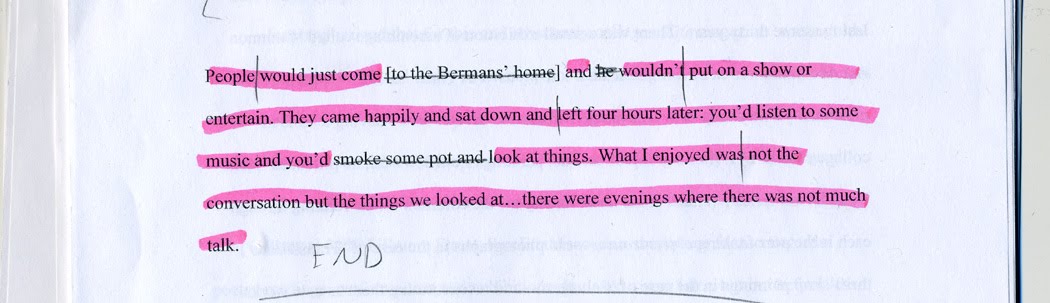
My studio was hung with a series of black and white drawings I had done. I hated them and started to pull them off the wall and tear them and throw them on the floor…. Then another morning began picking up torn pieces of my drawings and re-glueing them. Then I started. I got something going I started. People would just come and wouldn’t put on a show or entertain. They came happily and sat down and left four hours later: you’d listen to some music and you’d look at things. What I enjoyed was not the conversation but the things we looked at…there were evenings where there was not much talk.
And here we are in 2011. Nice to see you, as always. These past weeks I have had collage and de-collage on my mind. Below I have retyped and pasted in sections from a passage in Collage: The Making of Modern Art, by Brandon Taylor. That is the book that I have delaminated for the NewLights (De)Collage, and yes, all of the text is gone from my copy. But the text is still there in my other copy—I liked the book so much that I got two, knowing that one would be made into something entirely different. That book is the best broad survey of collage that I have read, and one of the main reasons for that is that it includes really interesting European artists (like Jiři Kolář, described in the passage below) that I had never heard of before reading the book. [Note: the book from which these passages were taken is a British book, hence the single quotes, etc.]
Jiři Kolář
Story, 1952
A confrontage.[…]
It was not until the end of the 1950s however that [Jiři] Kolář embarked on the vast experiment with the divided image for which he has become justly celebrated since. In a curious historical parallel, it was in the first years of French Lettrisme that Kolář’s unique experiment with the verbal image began, first as a ‘cut-up’ technique applied to given items of printed matter ranging from labels, recipes, mathematical formulae, and texts on medicine and astrology: such poems were collectively called ‘Instructions for Use’ and immediately endeared Kolář to concrete poetry movements further west. ‘From the beginning’, Kolář has said, ‘my concern was to find the interfaces between the fine arts and literature. All previous attempts in this direction seemed inadequate, and above all not consistent’. Imprisoned for most of 1953 and officially debarred from publishing until 1964, he nevertheless created from 1961-2 entire series of sign-poems, number-poems, puzzle-poems, and eventually ‘silent’ poems composed of hyphens, question-marks, commas and other resources of the typewriter (some were dedicated to the memory of Malevich). Soon came object-poems, or things subjected to essentially literary structures such as repetition, rhyming, or inter-leaving, or books themselves which are ruined, torn or glued, as if evading the censor of his poetry by craftily switching into another medium. ‘Someday’, said Kolář, ‘it will become possible to make poetry out of anything at all’.
 Jiři Kolář
Baudelaire (Les Fleurs Du Mal) Series, 1972
I believe that this is a rollage, because it is made from two copies of the same image. One is inverted, which creates the strange mirroring-repetition.[…]
In prollage (another invented term) he takes two or more images, and having cut them into identical width strips reassembles them in sequence: prollage stretches images lengthways, giving a behind-bars appearance that is also a simultaneity-effect whose purpose is to tease the mind and the eye. A variation known as rollage (from 1964) meant cutting several copies of the same image into strips and then mounting them in staggered sequence, creating a dazzling ‘optical’ effect not unlike Op Art in the West. ‘My head was bursting when I realized the possibilities which opened up for me when I put together the first two reproductions for the first time. I was permeable and so was the whole world; a non-illusionistic space could be created…’.
[…]
‘Rollage has enabled me to see the world in at least two dimensions’, he has said; ‘the stratifications made me realise just how many unknown layers make up life and just how many unknown deposits exist within each of us’.
[…]
Not trained as an artist, he has seldom invented a line or cut a silhouette that was not already given in the image in front of him—this too confirms his status as a writer for whom ‘poetry’ resides in images that resemble, dissemble, repeat or inhabit each other, and perhaps never more so than in the recent series known as intercollage which exploits the Magritte-effect of silhouetting one reality into (or through, or against) another
[…]
True to his writer’s mission, Kolář compiled a Dictionary of Methods, published in Paris in 1986, in which he articulates all the other techniques of his invention such as ventillage, crumplage, kinetic collage, and which underline further still his affinity to conceptual classification, lexicography, systematization, seriality: not only an implacably anti-Romantic attitude to the image, but one attuned to the linguistic as such. ‘The world attacks us directly’, he has said, ‘tears us apart through the experience of the most incredible events, and assembles and reassembles us again. Collage is the most appropriate medium to illustrate this reality’.
[…]

Jiři Kolář
Cow Having Eaten Up Canaletto, 1968
An intercollage.Full Citation!Brandon Taylor, Collage: The Making of Modern Art (New York: Thames & Hudson, 2004), 181-186.
Or perhaps just the Pennsylvania, which is close, which is just as good. But I will be away from the Internet, so there will be no posts next week. We will resume our discussion(s) in the New Year. Here's to another one, another try, an even better one. See you on the other side.
Open publication - Free
publishing -
More poetryI just recently found out about the above exciting thing. What I want to draw your attention to is not the text (Flight Test by Lewis Warsh), or even the book (published by Ugly Duckling Presse in 2006), represented above, but the device of representation itself. It’s a little program that comes through this site:http://issuu.comThis could actually be extremely useful for publishers and book artists. Small edition books that have gone out-of-print could have a second (if somewhat weird and ghostly) life on the web. Or maybe not out-of-print, but brand new, and readers can actually get a sense of the interior, of the “total object, complete with missing parts” before they buy the thing. Obviously not as good as the actual book (because you lose the materiality, the wonderful physical-ness that determines a reader’s relationship to the object through its functionality) but I think more representative than a flat PDF. Of course you can print a PDF, which has its own advantages. (But you need a real website to post PDFs. I can’t seem to do it from this silly little blog.)What I’m wondering about particularly is the capacity of Issuu to handle the altered books. Could it do a 200+ page book, of which every page is an image? The specs on the site (of the “professional” version) make me think it could. You could finally read those damn things.There’s also something significant in the fact that I just reposted someone’s complete book. It adds new possibilities for sharing and distributing texts/books. It will help us get the words out, which is, of course, what we do.
I've been writing the text for a new(ish) altered book. The book itself is subtractively constructed by a systematic removal of all the text and images through delamination. So the new text (laid in with stencils and also delaminated) is also written subtractively, by crossing out words from the text of the source book (Collage: The Making of Modern Art, by Brandon Taylor). What follows is the first draft, which may or may not be quite enough text. I can't be sure until I finish stenciling the mock-up. But here it is:The method of constructing from parts. It is the synthesis of colourless, white or grey-black areas of colour, or the arrangement of unexpected proportions. Written in the graphics of a powerful weapon aware of the very different demands of concluding that the system of montage is dialectic. It is a statement, after all, that neither Klutsis or Lissitzky could have made; nor Heartfield or Hoch, “Lyricism is the crown of life: Constructivism is its already existing soft-porn surfaces, even, on occasion, a castrating machine. Yet the most persistent motif is one that only collage as a device could generate: the softness of parts not only indexically presented but eroticized as a purely photographic contrast of textures: grass, gravel or wood, inside barbed-wire, in the midst of dry leaves, or, in one case, inverted on the body and placed against the austere brick superstructure. Such works not attempted hitherto: the minutest visible variations in photographic color and tone, magnified by the tell-tale curves of the paper’s scissored edges. By systematically excising one and placing it against a subtly contrastive one, an interval, a gap, which is in itself stimulating. ‘It is sight’, he had suggested, proposing desublimation of the senses: ‘The optical environment in which ‘the development of a bland, large, balanced, Apollonian art…in which an intense detachment this detachment that enabled him to see a Cubist collage by Picasso or Braque in a radically anti-illusionistic way: ‘the Cubists always emphasized the identity of the picture as a flat and more or less abstract pattern rather than a representation’. To choose between them is preferable to ambiguity: collage had now attained to the full and declared three-dimensionality we automatically attribute to the notion “object”, and was being transformed, in the course of a strictly coherent process with a logic all its own, into a new kind of houses we live in and furniture we use’. rectangles littered with small pictures rectangles are references to technology, the industrial process, heavy machinery. Thirdly, as a physical object it occupies a kind of middle ground between the single, exhibitable object and the flickering succession of a moving film. Turning its pages is a one-person affair, addressed to relatively private experience as opposed to the collectivity of a show. Yet politics was never far away. To that extent it may be mourning the flowering of quiet defiance: she knew such works could not be exhibited. But she was increasingly vulnerable. She was being watched and possibly denounced, she managed to escape attention. text written in opposition to works of ‘degenerate’ modernism is positioned close by. The art historian T. J. Clark has studied the problem: the work to annihilate the negation of the negation’. she boldly mangled several works to produce collage of her own. The background to this benevolent act of ‘completion’ is inevitably complicated by Krasner’s relationship to Pollock. ‘”Waste not, want not”, open it out and let space back in, it turns out that Krasner had her own adventure tumbling, thinking that Krasner soon became disenchanted with the work. My studio was hung with a series of black and white drawings I had done. I hated them and started to pull them off the wall and tear them and throw them on the floor…. Then another morning began picking up torn pieces of my drawings and re-glueing them. Then I started. I got something going I started
A Quick Study: Order, Number, Repetition, Standardization, Variation (in the malleability of the computer)QQQQQQQQQQQQQQQQQQQQQQQQQQWWWWWWWWWWWWWWWWWWWWWWWWWWEEEEEEEEEEEEEEEEEEEEEEEEEERRRRRRRRRRRRRRRRRRRRRRRRRRTTTTTTTTTTTTTTTTTTTTTTTTTTYYYYYYYYYYYYYYYYYYYYYYYYYYUUUUUUUUUUUUUUUUUUUUUUUUUUIIIIIIIIIIIIIIIIIIIIIIIIIIOOOOOOOOOOOOOOOOOOOOOOOOOOPPPPPPPPPPPPPPPPPPPPPPPPPPAAAAAAAAAAAAAAAAAAAAAAAAAASSSSSSSSSSSSSSSSSSSSSSSSSSDDDDDDDDDDDDDDDDDDDDDDDDDDFFFFFFFFFFFFFFFFFFFFFFFFFFGGGGGGGGGGGGGGGGGGGGGGGGGGHHHHHHHHHHHHHHHHHHHHHHHHHHJJJJJJJJJJJJJJJJJJJJJJJJJJKKKKKKKKKKKKKKKKKKKKKKKKKKLLLLLLLLLLLLLLLLLLLLLLLLLLZZZZZZZZZZZZZZZZZZZZZZZZZZXXXXXXXXXXXXXXXXXXXXXXXXXXCCCCCCCCCCCCCCCCCCCCCCCCCCVVVVVVVVVVVVVVVVVVVVVVVVVVBBBBBBBBBBBBBBBBBBBBBBBBBBNNNNNNNNNNNNNNNNNNNNNNNNNNMMMMMMMMMMMMMMMMMMMMMMMMMM[or maybe]111111111122222222222222222222333333333333333333333333333333444444444444444444444444444444444444444455555555555555555555555555555555555555555555555555666666666666666666666666666666666666666666666666666666666666777777777777777777777777777777777777777777777777777777777777777777777788888888888888888888888888888888888888888888888888888888888888888888888888888888999999999999999999999999999999999999999999999999999999999999999999999999999999999999999999
 A nice weekend with some long hours in the studio. Below are some shots of the first stages of printing the black plates on What You Will. It's satisfying, after all this time, to see that pages start taking shape (and this book is all about its pages taking, having, shape).
 And a Cautionary TaleI've discovered one minor drawback to the plastic-backed photopolymer plates: they warp like crazy, if you don't store them properly. If you do store them properly (in a sealed plastic bag, flat, and in the dark) then they will be fine.
  These plates were so warped and hardened from gradual light exposure that they wouldn't stick flat to the base, even under pressure from the press. That's a lot of wasted time & money, unnecessary delays, etc., so let this be a lesson. Store your plates properly!

When I first read the passage transcribed in the last post, from Darren Wershler’s The Iron Whim, I was, I admit, a bit confused. The idea that “no one is ever alone at a typewriter” didn’t quite make sense to me. Here I am typing, in the dark of the morning, and I feel pretty alone (even though these words address you, Reader, but you are just a piece of my imagination, or a memory, & that is another story). Obviously, when transcribing a passage from a book, one is taking a sort of dictation. But when one is writing, “generative typing” as it’s called in the book, where is the dictator? Am I not writing this?And then I saw it. My body is not doing what my mind is doing. My mind is making up words. My body is transcribing them into/onto this electronic surface. This is not my inner voice, projected pure and clean and forcefully through the electronic channels. This is a transcription, an abstracted representation, of that voice. The technology of writing (of the written alphabet itself) and the technology of the computer force a separation between myself and “my” words. The alien, borrowed, learned, cultural nature of language (all that Other stuff, that comes from you, Readers) becomes apparent. Aaron Cohick wrote, or typed, this, but I did not say it.So the writer, sitting at his/her computer/typewriter/notebook, is a part of a larger machine. So the artist, sitting/standing in his/her studio in front of whatever it is that he/she does or makes, is part of a larger machine. So the act of construction is always dictator + “writing machine” + amanuensis. Or matrix + printing machine + printer. Or supervisor + office/factory machine + worker. We are always a terrifying mirror of our own inventions.I’ll be your mirror.I want to be a machine.The idea becomes a machine that makes the art.Where are we?
In which we discreetly make it happen[…]Typewriting always begins with something telling someone what to write.
“Follow these instructions as though they were being dictated,” commands the first sentence on Ruth Ben’Ary’s famous textbook Touch Typing in Ten Lessons, written in 1945 but still in common use today. Ben’Ary’s command spells out one of the secret rules of typewriting: at some point, even a lone “generative” typist has to learn to type by following someone else’s dictation, without question. Sometimes a book or an instructional audiotape or a piece of software or even a half-assed personal notion of how to hunt-and-peck one’s way across a keyboard substitute for the stern voice of the high-school typing teacher. All of these possibilities amount to the same thing: someone or something, even if it’s just another part of ourselves, dictates to us, tells us what to write until we internalize and forget about it. Even then, the dictatorial voice that makes typewriting possible very often comes back to haunt the typist, after being split, stretched, twisted, and transmogrified into something uncanny and alien by the typist’s imagination. In other words, no one is ever alone at a typewriter.
What actually produces typewriting turns out to be a surprisingly variable assemblage of people and machines. From the relative beginnings of typewriting, this assemblage has consisted of three positions. There is a space for a dictator—the source of the words that are being typed. There is a space for a typewriter—that is, an actual writing machine. And there is a space for the person who is actually operating the machine—an amanuensis (“One who copies or writes from the dictation of another,” from the Latin for “hand servant” + “belonging to”). The problem is, it can be very difficult to determine who—or what—is occupying any of those positions at any given time.
[…]In some cases, dictator and amanuensis can and do change positions, or a new dictator or amanuensis can take up where the previous one has left off, all without leaving any clues as to this occurrence in the typescript. The amanuensis can also change the dictator’s words, deliberately or accidentally. In any event, “I” and “you” create a typewritten document together, and from reading that document, it’s usually impossible to tell whose words ended up on the paper. Typewriting confuses you and I. In his analysis of Franz Kafka’s first typewritten letter, Friedrich Kittler spots twelve typos, over a third of which involved the German equivalents of “I” or “you,” leading Kittler to observe that it’s “as if the typing hand could inscribe everything except the two bodies on either end of the…channel.”
[…]The above passages are from:Darren Wershler [-Henry], The Iron Whim: A Fragmented History of Typewriting (Ithaca: Cornell University Press, 2005), 74-75.
 Going to take a break from the hand-mechanical, at least writing about it, at least for a day, and try to put something up here that’s a little more human(e) perhaps. But what’s more human than being connected to a machine? What’s more humane than a simple, quiet task to accomplish? But no, not today, and at any rate, there are books, always & infinitely.
I have been reading Alan Loney’s The books to come, hot off the Cuneiform Press. Alan Loney is a writer-printer-bookmaker from New Zealand, who now lives in Australia. His new book is a collection of essays on the Book, the book, books. Right now all I will say about it as a whole is that it is an interesting read (I am preparing to write an actual review of it, hence this post, this blog acting as a thinking and reading space). It is not a hard, linear, straight-through kind of a book, but is divided into small sections, and the pace wavers, doubles back, accumulates slowly (festina lente) and deeply, somewhere out there, somewhere in here, in a quiet domestic space, in an infinite literary space. What shabby portals we are. From the book, the Book, the books to come:
[…]
my library does not belong to me, or, I can own a volume but not a composition, own a book, but not a text, not even a text of my own composing. Could we say: no border crossing between books and texts is possible, for if this were not so, one would have to deny that the principle of indeterminacy operates here. And yet there is a plethora of claims thruout the world of the book about blurring boundaries, extending borders, hybridization, category transgressions and so on every day. Do not these claims rely upon a fixity of category formation that was actually never true. The supposed edges of the categories always were straw edges, and the language of their apparent violent demolition was always a straw victory
reading a book and reading a text is an example of indeterminacy. We cannot do both at once. There is instead a sort of shuttling back & forth (loom-shuttle, weaving, textura) however rapid, between the two. Even in the case of the books of William Blake. It is simply that human attention is monocular, and our stereoscopic vision merely gives us a depth of field. And wouldn’t being able to see both sides at once imply that our experience is atemporal, permitting us to transcend the detail, the particular, the contingent that would pin us down. But in any articulation of any experience we speak or write as anyone does, one word after the other, one word or element or object at a time. Unless one’s understanding of time & succession is all wrong, and that ‘one word at a time’ is an inaccurate way of talking about how we talk and how we write. For at this point I remember that the writing of the ancient Greeks prior to the 5th century BC knew no word spaces. But looking at one word renders all other words in its vicinity almost invisible. Looking at an image renders the environmental context of that image invisible. Foreground/background, reading/viewing, focus/panorama, detail/overall impression, indeterminacy everywhere
what single written composition does one’s own library, one’s own collection of volumes, make. What sort of a book is one’s library. What book does the accumulated libraries of all of us amount to. Louis Zukofsky famously avowed that all one’s life one only wrote one poem. It allows the nice possibility that all poems from a certain context, all L=A=N=G=U=A=G=E poems for example (let’s allow for the moment that such things do exist), are a single poem, parts of which are distributed about various, diverse, even conflictual writers. It reminds me of a Terry Riley composition in “Cadenza on the Night Plain” where a Dream Collector has a specific and finite number of dreams to distribute and redistribute thruout the populace after collecting them from the dreamers in the morning. So the library at large, that collection of books scattered yet gathered over the planet, is itself a single book, containing a unitary text, the variety and complexity of which is unencompassable by any individual, any tribe, any nation, any book, even the entire populace, those millions who every day die and are born, dropping as a species, as it were, into & out of the text
[…]
Those three passages actually do fall in that order, in tandem, in the fourth chapter of the book, “What book does my library make.” Full Citation! Alan Loney, The books to come (Victoria: Cuneiform Press, 2010), 88 – 90!
From 6a[…] Every piece in the edition is supposed to look exactly the same. Any copies that are noticeably different from the others are excluded. The amount of variation tolerated in an edition varies from artist to artist, from piece to piece, from context to context. There is no “perfect” edition—every edition contains the very thing (variation, difference) that cancels its mode of being, that activates its mode of becoming. […] Where does the value of a hand printed object come from? Does that value result from the scarcity of the handmade object? Or does it come from the amount of labor and the quality of the raw materials invested in the object? Almost certainly some combination of all these things, with, perhaps, the desire of “the market” always reigning supreme. But let’s take a look at this labor, this work, that supposedly inheres in the hand-printed object.The labor of the artist/printer is valued, and so it seems safe to say that the presence of the artist/printer in the process of making is valued. But if every copy in an edition is supposed to look exactly the same, how is that labor-presence being real-ized? Generally speaking, we do not want to see our printers in our printed objects. The printer must become a machine, or a part of the machine, or a machine-like absence. The self dissolves, becoming a dispersed, motivating energy for the process. The printer is not there. Any sign of the printer, of the made-ness of the thing, is considered a flaw.From 6b[…] It can be said that the matrix is actually these two things: the object containing the information that re-produces the object-in-multiple, and the manner in which that information is actually used to carry out the production. Every matrix is information plus action. […]But we are supposed to see the artist, through their “style,” in the image. The artist’s presence is allowed in the construction of the information-matrix. The artist’s presence, and that guaranteeing authority, is necessary for the object to exist in an art context. The gathering and construction of the information-matrix requires an artist. The use of the action-matrix requires a printer. There is a separation of labor (and power) here, and that separation allows a physical separation of artist and printer—the artist does not have to be the one printing her own art. (This is one of the oldest outsourcing arrangements in the art world. Actually, workshop-oriented, dispersed production was the norm before the advent of “modern” art.) But the printmaker (the artist/printer) is split in her own process, always there, but there and not there, flickering between a human presence and a machine absence.Is the printer, essentially, just another part of the assemblage of the matrix? What kinds of meanings can the manipulation of that assemblage produce?
[The] process of [the stripe paintings was] simple-minded…. But it was a lot more intense; just doing those things, painting those stripes one after another is quite enervating and numbing. It’s physically fairly exacting…I couldn’t keep it up. The physical concentration…it was just a different kind of way of being a different kind of process. But the process was everything then, as it is now.
From 6a[…] Every piece in the edition is supposed to look exactly the same. Any copies that are noticeably different from the others are excluded. The amount of variation tolerated in an edition varies from artist to artist, from piece to piece, from context to context. There is no “perfect” edition—every edition contains the very thing (variation, difference) that cancels its mode of being, that activates its mode of becoming. […]\\\\\\\\\\\\\\\\\\\\\\\\\\\\\\\\\\\\\\\\\\\\\\\\\\\\\\\\\\\\\\\\\\\\\\\\\\\\\\\\\\\\\\\\\\ I have, for some time now, been exploring the concept of the “variable” or “variant” edition. This is another one of those paradoxical ideas—an edition that foregrounds difference. I’m not sure where the idea of the variable edition comes from originally—I learned about it in one of my first printmaking classes, so it’s a thing that’s been “out there” for awhile. It’s not a new idea, but it is a powerful one, because it is an idea that by its very nature questions its own core concepts (the edition, repeatability, the multiple) and the discourse in which it exists (the limited edition, the restricted economy). The variable edition is the edition “under erasure.”[Brief aside: Does the variable edition produce an object-in-multiple that questions the limited edition/restricted economy? Or does it produce an object-in-multiple that is perfect for the restricted economy because every copy is unique? Is the variable edition the ultimate limited edition? Is context/distribution relevant here?]There are many different ways to physically produce a variable edition, but we can identify two main approaches, and those approaches are determined by the construction and use of the matrix or matrices that produce the edition. It can be said that the matrix is actually these two things: the object containing the information that re-produces the object-in-multiple, and the manner in which that information is actually used to carry out the production. Every matrix is information plus action.[“Re-produces?” I love how slippery, muddy, and opaque the language gets out here. Like the grease and dirt caught under your fingernails after you’ve been working on a machine.]The closed matrix: The closed matrix is a matrix that contains information corresponding to every single mark or feature that will appear on/in the finished object. Everything is there already. And, importantly, the matrix is used in such a way that all of that information is automatically present in the finished object. The etched copper plate, the litho stone, the polymer plate, lead type, the photographic negative, the mold—all of these “normal” matrices are closed matrices, when used in their “normal” way—to physically and directly make an object. But it is also important to note that a digital file, interpreted through “normal” reproductive software, is also a closed matrix, because it will produce (barring the unavoidable physical peculiarities of the “interpreting” interface, generally, the screen and/or printer) almost exactly the same object over and over again. All of the information is embedded in that file. Digital printmaking, technically speaking, is no more or less radical than “traditional” printmaking. The open matrix: The open matrix is a matrix that contains just enough information to begin the action of making, and the relationship between the matrix and what is produced is often abstracted or removed. (A line on an etched copper plate physically and directly produces a line in that same shape. Instructions on how to draw a line will still produce a line, but the information is abstracted and only represents or describes the mode of production.) The action component of the matrix has chaotic or variant elements built right in. For example, an open matrix could be a set of instructions (the abstracted information), and those instructions could guide the re-production of a drawing (variation built in to the process). Or the information part of the matrix itself could be literal and closed (like a linoleum block) and the action component of the matrix could be open and chaotic (pouring or spraying solvent on the linoleum block after it has been inked).Both kinds of matrices, open and closed, can be used to produce a variable edition, and the “two main approaches” to making a variable edition mentioned above stem from these types of matrices.The first approach is the use of a closed matrix in a variety of ways within a single edition; for example, the same copper plate can be used to print a single edition in several different colors. This approach is, more or less, grouping different prints into the same edition because of the use of a common matrix. The second approach is, simply, to utilize an open matrix, which, because of its active, chaotic elements, always produces a variable edition.//////////////////////////////////////////////////////////////////////////////////////////////////////////Every edition ever is variable to a certain degree. Any set of information translated or transposed to a new physical form inevitably incorporates a certain amount of variation. Such is the nature, the chaos, of the world. What matters though, is the threshold of perceptibility of that variation. If there are two prints on the table, and no one can see the differences between them, are they different at all?
 These images are from the Wikipedia article on the Difference Engine, an early mechanical computer.




 Posts
Posts


